
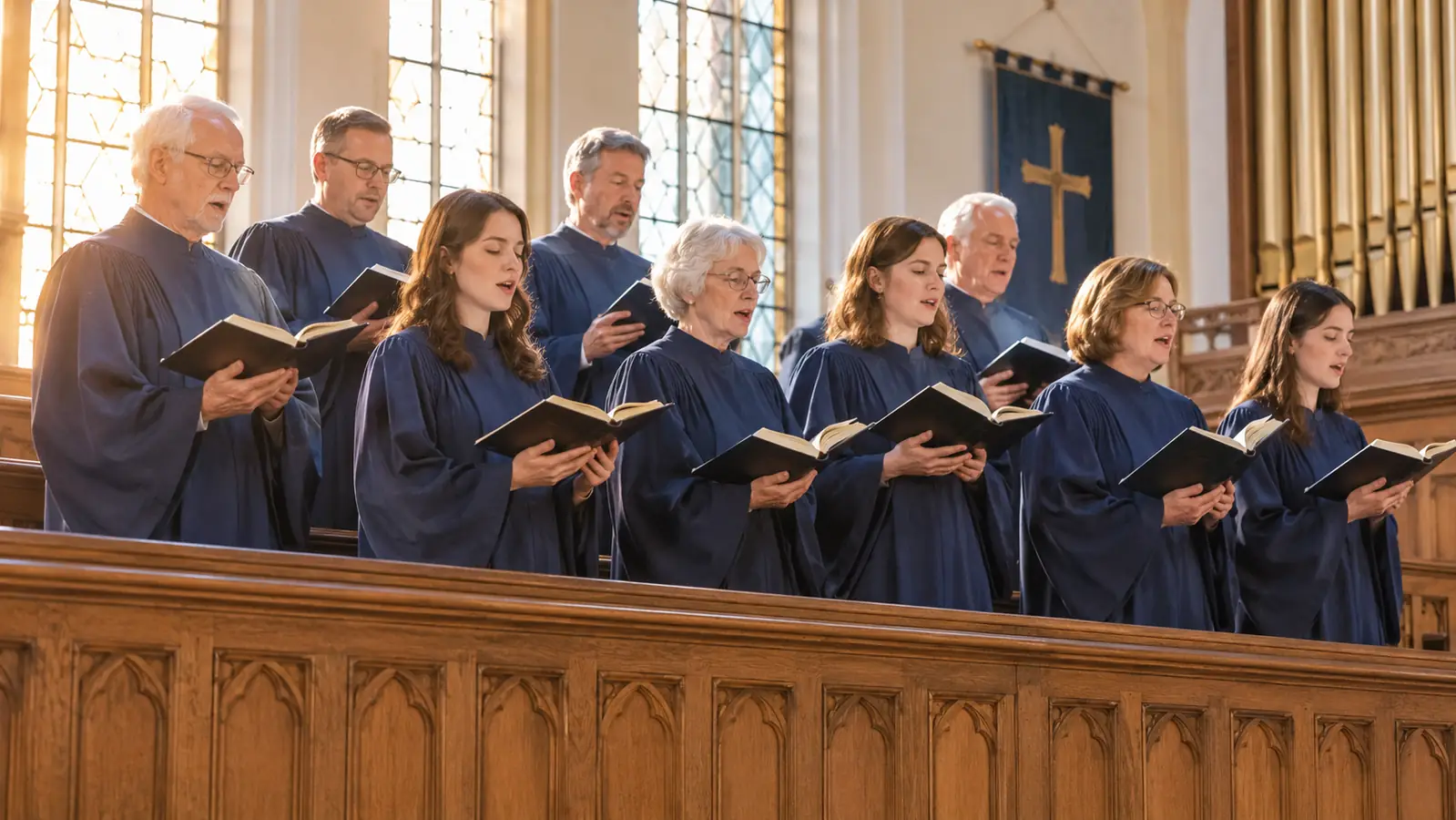
Our robe closet is a converted supply cabinet in the fellowship hall, and every August I open it with the feeling a person gets opening a cooler they forgot about over a long weekend. Thirty robes. Most of them older than some of the sopranos. And a budget that would not cover a nice dinner out for four. I am the volunteer wardrobe coordinator for the adult Sanctuary Choir at Greater Mount Zion, which is a polite way of saying I wash, hem, label and quietly worry about all of it.
Last spring the robe committee finally let me order something new. We did what we always do, which is look at the same three catalogues, argue about whether the old ones could survive one more Christmas, and then order a single robe to test before anybody commits to thirty. That test robe was a GradPlaza choir robe. I have now worn it through a full season of Sunday mornings, an Easter service, a spring concert, and one baptism where I stood at the back praying nobody would notice my hem line. Here is what I found, from the alto section, where I have stood for thirty years.
The Quick Verdict
A lightweight polyester robe with a loose V-neck fit, a calf-length hem and a machine-wash care label, and it held up through eleven washes and a whole church season. Order one size up. It will not feel like the heavy old robes in the back of your closet, and for a warm sanctuary that is the point.
Amazon Check Today's Price →The robe we tested for a season before we ordered for the section
Lightweight polyester, V-neck, calf length, machine wash. One test robe answered every question the committee had, and answered them cheaper than a full order would have.
Amazon Check Today's Price on Amazon →How I've Used It
I am five foot four and built like somebody's grandmother, which I am. The listing itself says the fit runs slightly small, and I appreciate a seller who says that out loud, so I ordered the size 48 and tried it on over a blouse in the fellowship hall bathroom with the door locked and my shoes off. The V-neck sat where a V-neck should sit. The body was loose enough to move in without looking like a sack, which is the fit description the listing gives, loose, and it is accurate. Nothing pulled across the back when I raised my arms the way we all do on the last line of the benediction hymn.
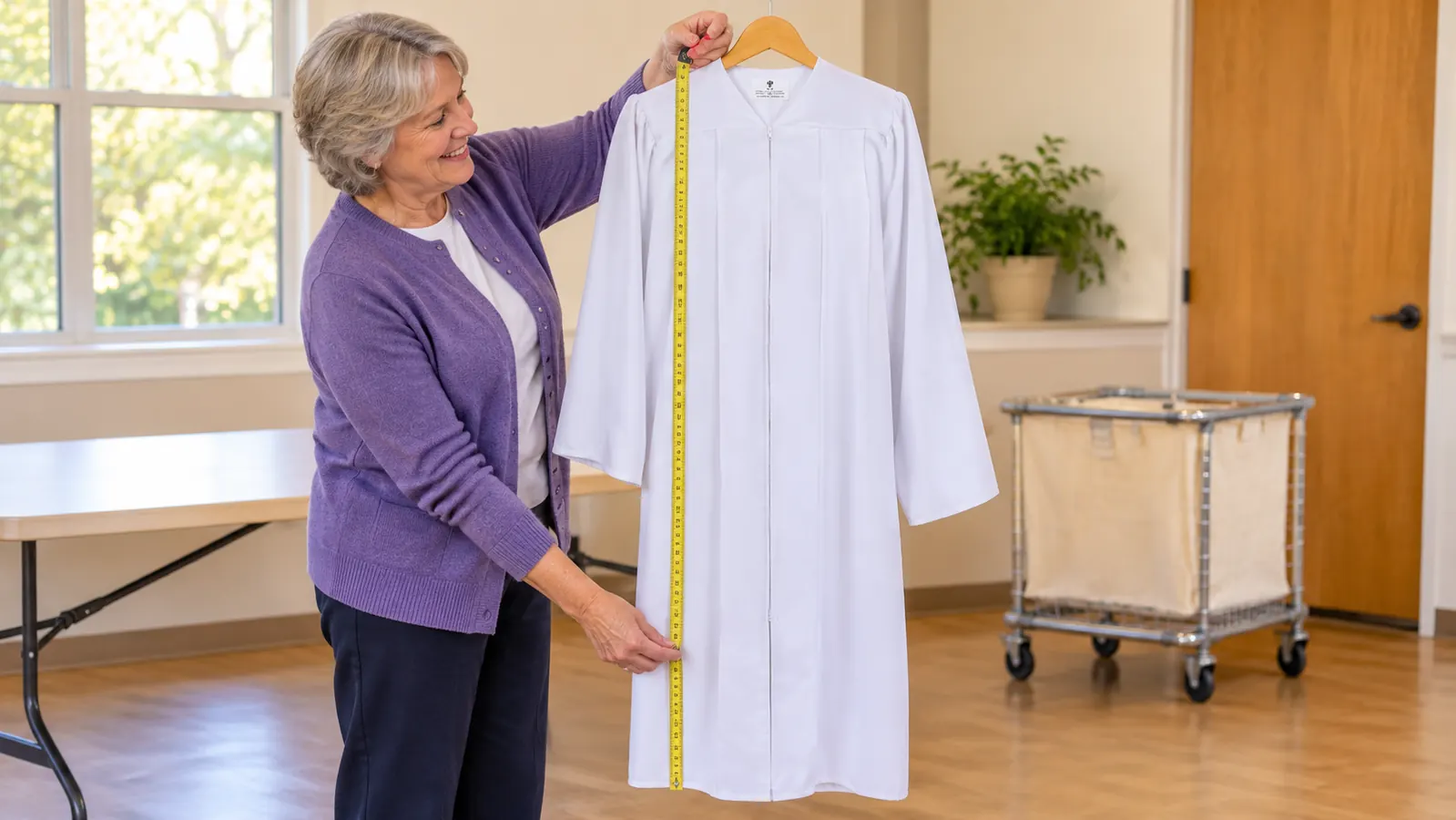
The length is the part I care most about, because our risers are steep and I am not the only short woman in the alto section. The listing calls it calf length. On me it hit a couple of inches below the knee, which is fine for standing and just barely fine for the one song where we sit. If you are taller than about five foot eight, do the math before you order thirty. Calf length on a tall woman is a different garment than calf length on me, and the committee needs to hear that before the order goes in, not after.
Weight matters more than people think. The listing gives 0.35 kg and puts the fabric in the lightweight class. I noticed it most in July, when our sanctuary gets warm under the lights and the old robes turn a Sunday morning into a slow bake. I wore this one through two summer services and never once had that moment where you consider fanning yourself with a bulletin during the offertory. That alone made the committee listen to me.
The listing also covers baptism and graduation ceremonies, so I tested that claim in June when we baptized three young people and needed robes in a hurry. The GradPlaza robe went over a blouse and slacks and looked like it belonged, because a solid ceremonial gown does not argue with the occasion. That is worth knowing if your church does baptisms in the sanctuary and has to dress candidates in something on short notice. One garment that serves two purposes is how a small church budget survives.
I also wore it at Easter, which is our longest service of the year. Two hours, up and down four times, one processional that crosses the whole room, and a lot of standing while the children's choir does their two numbers. I was tired at the end because I am sixty-three, not because of the robe. That is a distinction worth making when you are the person who has to answer for thirty of them.
The Fabric Question: Polyester Under Sanctuary Lights
It is polyester. The listing says so plainly, and I want to be plain about it too, because some choir members hear polyester and picture a graduation gown that crackles every time they breathe. This one does not crackle. It has a quiet, solid hand to it and it hangs instead of standing up on its own. The pattern is solid, which for a robe means no print, no stripe, nothing that competes with a stole or a cross. Is it the same as the heavy robes our founding members wore? No. Nothing at that weight is going to feel like a bank vault door, and I would rather have a robe a seventy-eight-year-old alto can wear in June than a robe that honors tradition by making her dizzy.
What polyester does well in a church is hold up. We have robes in that closet that have been washed so many times the seams have given up, and they were not polyester, they were something that looked lovely for four years and then started to go thin at the shoulder. Polyester keeps its shape through repeated washing, which matters a great deal when you are the person doing the washing, on a Tuesday, with a folding table and a stack of hangers and nobody helping.
What it does not do is breathe like cotton. Under lights, in a room with the doors shut and two hundred people in it, you will feel it against your back. It is better than what we had. It is not the same as wearing nothing, and I want you to know that before you order thirty and then hear about it in the parking lot from the one person who was going to complain anyway.
I would rather have a robe a seventy-eight-year-old alto can wear in June than a robe that honors tradition by making her dizzy.
Sizing, Calf Length, and the Hem on the Risers
Here is the thing nobody tells a robe committee: your choir is not one size. We have a soprano who is four foot eleven and a bass who is six foot three, and every order we have ever placed has involved one person standing on a chair while somebody else pins a hem with her mouth full of straight pins. GradPlaza runs slightly small by their own description, so we built in a size up for anyone sitting between two sizes, and that turned out to be the right call almost every time.
The calf-length hem is easier to work with than a floor-length robe. On the risers, a floor-length robe catches under your heel when you step up to the top tier, and I have seen a woman go down. A calf-length hem clears the step. It also means that when a singer is shorter than the size chart assumed, the fix is a turn and a stitch instead of a full re-hem with a measuring tape and a steady hand.
One warning about the fit: loose is loose. If your choir is used to robes that skim the body and you move them into this, the first Sunday will produce comments in the ladies' room. Give it a week. By the second Sunday nobody mentions it, because they can lift their arms and breathe at the same time, and that turns out to matter more than how they look in the mirror.
Laundry Day in the Fellowship Hall
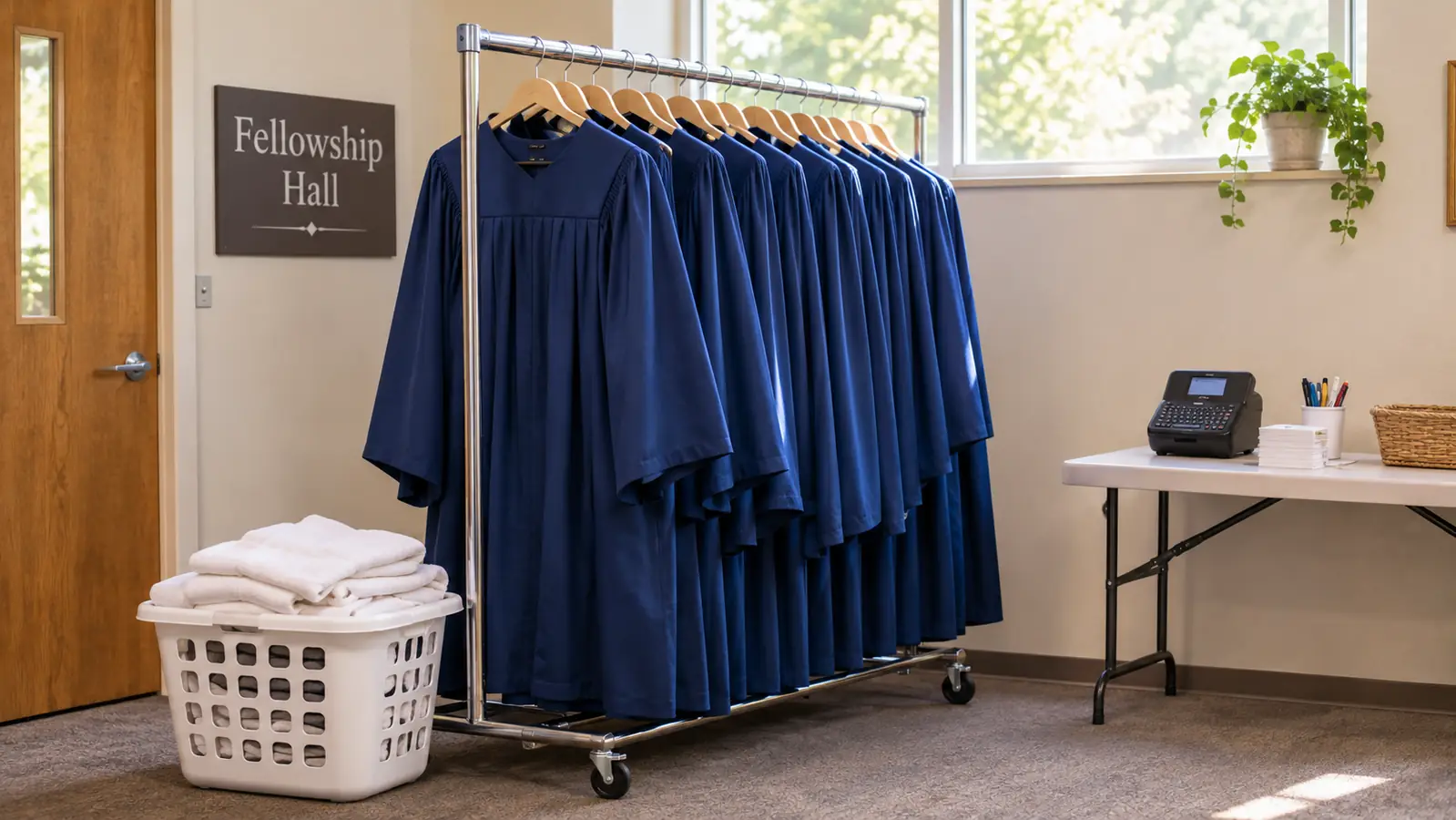
The care instruction on the listing is machine wash, and I took that literally, because I am the one who has to do it. Thirty robes do not go to a dry cleaner on our budget. They go in the machine in the fellowship hall kitchen, a few at a time on a gentle cycle, and then up on hangers on the rolling rack by the window. I have washed the test robe eleven times since spring. The shoulders have not stretched out. The V-neck has not pulled. The hem has not gone wavy, which is the failure I was expecting by wash number six.
I hang it to dry rather than putting it in the dryer, mostly out of habit, and partly because a hot dryer is how hems go wrong. That is my practice, not a rule from the seller. If your church has a dryer and a Sunday morning time crunch, test it on one robe first. That is the whole method here, one robe, one wash, one season, before the closet.
I sewed a name tag inside the collar, as I do with every robe we own, because otherwise thirty robes migrate and by Christmas the tenors are wearing the sopranos' robes and everybody blames the wardrobe coordinator. The fabric took a needle without any trouble.
What the Choir Said After Three Months
We put six singers in the GradPlaza robe before committing to anything, chosen on purpose: the tallest, the shortest, the one who overheats, the one who complains, the one who has been in the choir since 1979, and me. After three months the complaints were mostly that the fit was looser than they were used to. Two people asked to go down a size after the first wearing, and we let them, because a robe you fidget with is a robe you resent by March.
The one who overheats said, and I am quoting her exactly, "I did not have to think about it." That is the highest compliment a robe can get in our loft. Nobody in the congregation is going to notice your robe on a Sunday morning. They notice when the choir looks uncomfortable. They notice when thirty people are all tugging at the same shoulder seam at the same moment during the second verse.
The oldest member of that group, who has sung through four pastors and two building programs, gave it the longest look of anybody and then said it was better than she expected for the weight. From her, that is a five-star review delivered flat. She also asked whether we were getting them in time for the Christmas cantata, which is her way of saying yes.
Where It Falls Short
It is not a formal vestment. If your church's tradition calls for something with real weight and a proper academic cut, this is not that, and I would not pretend otherwise. It reads as a clean, simple ceremonial gown, which is the phrase the listing uses, and it is honest about being lightweight polyester at 0.35 kg. That honesty is worth something when you are the one answering questions from a committee.
The sizing is the other shortfall. Runs slightly small is not a suggestion. We had to exchange two of the six test robes, and an exchange costs you a Sunday and a trip to the shipping counter. Measure your people with a tape, write the numbers on an index card, and order from the card, not from what size they wear at the department store.
And it will not last thirty years like the ones in the back of our closet that weigh as much as a toddler. I doubt it will. But those robes were paid for in a year when the church had a different budget and a different choir, and half of them do not fit anybody currently singing. A working robe for the people in front of you is not a compromise. It is the job.
What I Liked
- Lightweight polyester that stays bearable under warm sanctuary lights
- Machine wash care label, and the shape held through eleven washes
- Calf-length hem clears the riser step instead of catching under a heel
- Loose V-neck fit lets a singer raise both arms without pulling the back
- Simple solid ceremonial gown that also works for baptism and graduation services
- The listing says plainly that it runs slightly small
Where It Falls Short
- Runs slightly small, so order one size up for anyone between sizes
- Polyester does not breathe like cotton under hot lights
- The loose fit takes a Sunday or two to get used to
- Not a heavy formal vestment, and it will not last three decades
- Very tall and very short singers will still need hem work
Who This Is For
This is for the choir coordinator with a closet full of robes that no longer fit anybody, a budget that will not stretch to custom vestments, and thirty volunteers who need to look like one body on Sunday morning. It is for the church that sings in a warm sanctuary and has at least one member who quietly stopped coming in July. It is also for the smaller congregation buying baptism robes or graduation robes, since the listing covers baptism and graduation ceremonies as well as choir use, and one garment serving two purposes is how small churches survive.
Who Should Skip It
Skip it if your tradition calls for a specific academic cut, a particular weight of fabric, or a vestment your pastor would recognize on sight from the back of the room. Skip it if you cannot measure your singers and order by number, because the sizing will punish guessing every time. And skip it if you need a robe to last three decades. This is a good working robe for a working choir, not an heirloom, and I would rather tell you that now than have you find out in year six with thirty of them on your rack.
Order one before you order thirty
That is how we did it, and it is how I would do it again. Machine wash, calf length, loose V-neck, lightweight polyester for a sanctuary that gets warm. Measure two singers, order two robes, and let the season decide.
Amazon Check Today's Price on Amazon →