

If your choir has ever stood under sanctuary lights in shiny satin and watched the front row turn into a mirror, you already know the question. The robe committee at Greater Mount Zion asked me the same thing this spring: should we stay with the look we have, or move the adult Sanctuary Choir into something calmer? I have kept our robe closet for years, washed more robes than I can count, and hemmed enough hems to know that a choir robe is not a costume. It is a tool for worship. The GradPlaza Choir Robe is the matte option I compared against the shiny satin robes many choirs still buy. My short answer: GradPlaza is the better daily robe for a volunteer choir, and satin still has a place for the right special service.
Here is the short answer in plainer terms. If your choir sings most Sundays, washes robes regularly, and wants a uniform that does not distract from the anthem, choose the GradPlaza matte robe. If your choir sings two or three high festival services a year and the shine is part of the tradition, shiny satin can still work. The trouble starts when a church buys satin for every Sunday because it looked lovely on Easter, then discovers the care, the glare, and the fit problems in ordinary week-by-week use. That is the comparison I want to walk you through.
| GradPlaza Matte Robe | Shiny Satin Choir Robes | |
|---|---|---|
| Finish | Matte polyester surface with a solid pattern | Satin weave with a glossy sheen |
| Fabric weight | Lightweight polyester, 0.35 kg | Satin weight varies by maker |
| Care | Machine wash, per the listing | Often hand wash or dry clean to protect sheen |
| Fit | Loose fit; listing says runs slightly small | Cut varies; shine shows every pull |
| Length | Calf length | Often calf or floor length, varies by maker |
| Neckline | V-neck | Varies by maker |
| Festival look | Solid, understated, quiet under lights | High shine for Easter, Christmas, and concerts |
| Photographs | Matte surface softens glare | Sheen catches camera flash and stage light |
| Coverage on risers | Loose cut and calf length keep hems clear | Satin drape can cling; hem depends on maker |
| Uniformity in a row | Solid pattern keeps the row visually even | Shine shifts with angle and light |
| Everyday wear | Built for weekly Sunday use | Better suited to occasional festival use |
Where GradPlaza Wins
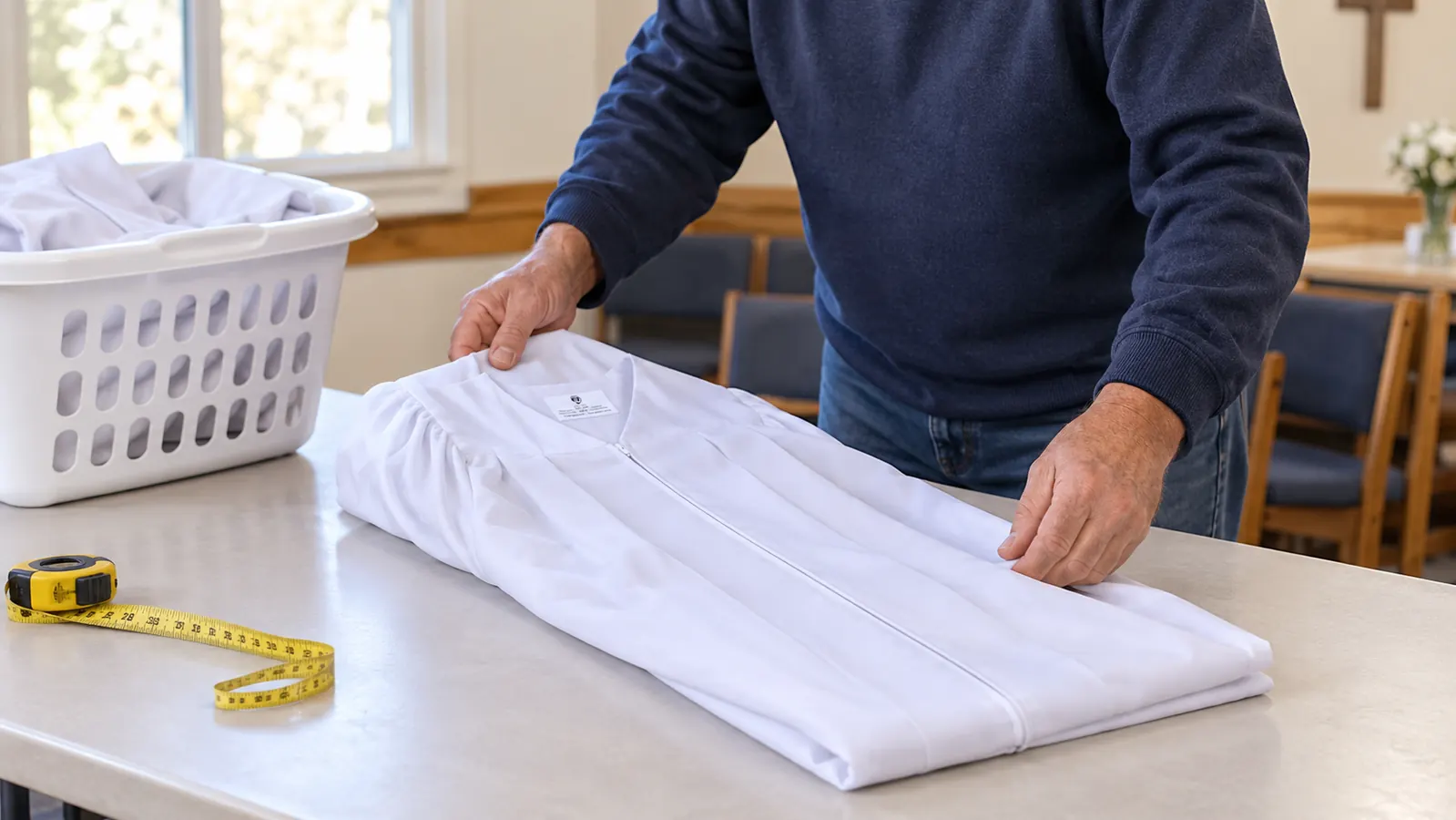
GradPlaza wins the ordinary Sunday. The listing gives you a polyester robe with a loose fit, a V-neck, a solid pattern, and calf length. It is lightweight, and the care instruction is machine wash. Those are the details I care about when I am standing in the fellowship hall with a rack of thirty robes and a washing machine that is already full. A robe that can be cleaned at home and worn without fuss is a robe that gets used.
The second win is the way it sits in a row. A solid pattern and a matte surface keep the choir looking like one body instead of thirty separate outfits. The loose fit gives room across the shoulders, which matters for singers who raise a folder or lift a hand during the anthem. The calf length keeps hems off the risers. GradPlaza is not trying to be flashy. That is the point. It is trying to be the robe you stop thinking about once the prelude begins.
Where Shiny Satin Wins
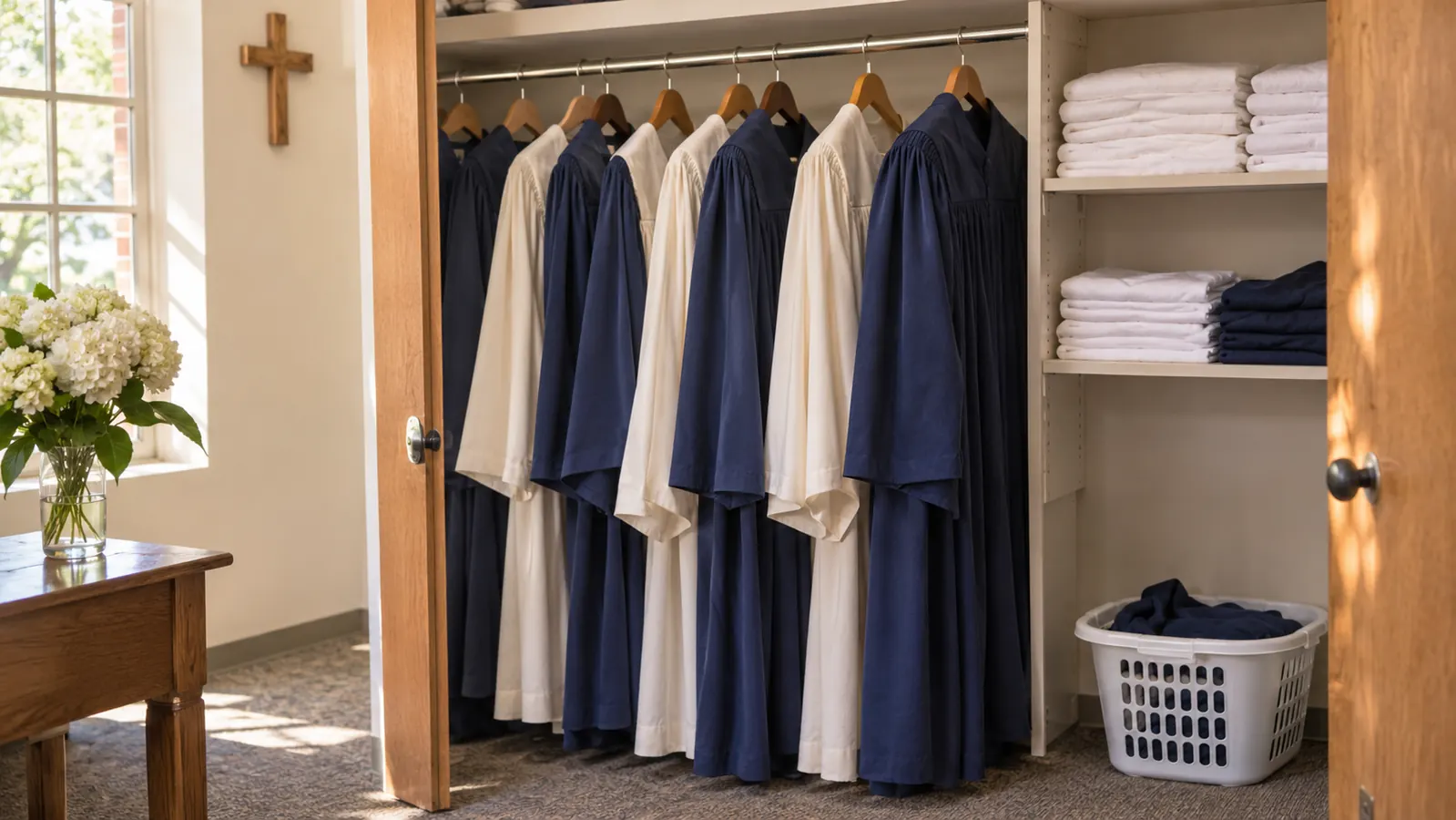
Let me be fair to shiny satin. For a festival service, it does something a matte robe cannot do. It catches the light. It gives the processional a sense of occasion. On Easter Sunday, with the brass playing and the sanctuary full, a row of satin robes can look wonderful. If your choir only robes for Christmas, Easter, and the spring concert, the shine may be exactly what your church expects.
Satin also has a formality that many church members associate with choir. The drape can feel dressier, and the sheen photographs with a certain drama. If your choir is small, if the robes are stored flat, and if someone on the committee is willing to handle the care, satin earns its place. I would not throw it out of the closet. I would just be honest about when it works and when it becomes a burden.
The robe that makes sense for ordinary Sundays
GradPlaza's choir robe is lightweight polyester with a loose fit, V-neck, and calf length. The listing says machine wash. If your choir needs one uniform for most of the year, start here.
Amazon See the GradPlaza Robe on Amazon →How I Compared Them
I did not run a laboratory test. I did what a wardrobe coordinator actually does. I took the GradPlaza robe out of the bag, checked the seams and the hem, read the care label, and put it through a normal week at Greater Mount Zion. I also pulled two shiny satin robes from our own closet, the ones we keep for Easter, and compared them side by side on the same table. I looked at four things: how each robe felt on a singer, how it handled the light, how it survived care, and how it behaved on the risers.
Our choir is about 30 voices, ages from late twenties to eighty. That matters. A robe that works on a slim teenage soprano may not work on a tenor who has been singing bass for forty years. The GradPlaza listing says loose fit, and that is the right starting point for a volunteer choir. Shiny satin can be cut generously too, but the shine makes every pull and wrinkle more visible. In a row of thirty people, that is not a small thing.
I also paid attention to the label facts. The GradPlaza robe is polyester, machine wash, lightweight, calf length, V-neck, solid pattern, and the listing notes it runs slightly small. The size shown is 48. Those are not glamorous details, but they are the details that decide whether a robe gets worn every Sunday or stays on the rack until Christmas.
The Care Difference in a Church Closet
The biggest difference is not on the hanger. It is in the fellowship hall on Monday morning. Shiny satin looks beautiful until it meets a washing machine. Many satin robes need hand washing or a trip to the cleaners to keep the sheen. That is fine for a handful of festival robes. It is a burden when you have thirty robes and a hot Florida summer.
GradPlaza lists machine wash care. I do not pretend that every machine wash is gentle, and I would still use a mesh bag and a cool cycle if the label allows it. But the option changes the math for a church closet. A robe that can be washed at home is a robe that can be worn in July without dread. It also means a stain from communion juice or a dropped bulletin does not become a crisis.
Satin has a real advantage here in one narrow way: it looks dressy with less structure. But that advantage disappears if the robe cannot be cleaned easily. For a choir that sings every week, care instructions are not a small print detail. They are the difference between a uniform and a museum piece.
A choir robe is not a costume. It is a tool for worship, and the best tool is the one that can be washed, worn, and forgotten while the anthem is sung.
Fit, Sizing, and the Risers
The GradPlaza robe is a loose fit, and the listing says it runs slightly small. I would take that seriously. If a singer is between sizes, go up. A loose robe that skims the body is easier to move in than a tight robe that pulls at the shoulder. The V-neck also gives a little room at the collar, which helps when a singer is warm.
Calf length is another practical detail. On our risers, a floor-length robe can catch under a heel when a singer steps up or down. Calf length keeps the hem clear. It still looks formal, and it still reads as a robe from the back row. Shiny satin robes often come in floor length because the drape is part of the look. That can be beautiful in a processional, but it is one more thing to manage on a Sunday morning.
The listing shows size 48. Our closet has a range of sizes, so I would not treat one size as the whole story. I would check the size chart, measure the singer, and order with the runs-slightly-small note in mind. Satin robes vary by maker too. The difference is that satin hides less. A poor fit in satin is visible from the pulpit.
What the Choir Noticed on Sunday
I asked a few singers to wear the GradPlaza robe for a Wednesday rehearsal and then for Sunday service. The first comment was not about looks. It was about movement. The lightweight polyester did not feel heavy on the shoulders, and the loose fit gave room to breathe and to raise a folder. That matters more than most robe committees expect.
The second comment was about the quiet. A matte finish does not flash under the sanctuary lights. When the choir stands in a row, the eye goes to the faces, not to the reflection on a sleeve. One alto said she felt less like she was on display. That is a good feeling for a volunteer choir.
The satin robes got a different reaction. People noticed them. The shine caught the light during the processional, and for a festival service that was exactly right. But the same shine showed every crease from the storage box. We had to steam them before service. That is the trade: satin gives you drama, and it asks for attention.
A Note on the Room and the Lights
Our sanctuary is not a cathedral. It is a good-sized room with a balcony, a simple cross, and lights that get warm by the second service. In that room, a matte robe disappears into the background in the best way. The choir looks unified without looking like a lighting display. If your room already has a lot of visual texture, stained glass, banners, brass, a shiny robe adds one more thing for the eye to sort out.
A larger church with a long aisle and a formal processional may want that shine. Satin can look wonderful in a room with high ceilings and dim lighting because it catches what light there is. The key is to match the robe to the room and the service, not to buy one robe for every occasion and hope it works.
Who Should Buy Which
Choose the GradPlaza matte robe if your choir sings most Sundays, if you wash robes in house, if your singers range in age and size, and if you want a uniform that stays quiet under the lights. It is also the better choice if your budget has to cover thirty robes rather than three. The machine wash care, lightweight polyester, loose fit, and calf length are the details that make it a working robe.
Choose shiny satin if your choir only robes for Christmas, Easter, and the spring concert, and if the shine is part of your tradition. It is also a reasonable choice for a small ensemble that can hand wash or dry clean and store the robes flat. If your heart is set on satin, do not buy it for every Sunday and then resent it. Buy it for the services where it belongs.
If you are deciding for a whole choir, start with the ordinary Sunday. That is the service that wears a robe out. The festival service is the one that makes the photographs. A robe that works for both is ideal, but if you have to choose, choose the one that survives the ordinary Sunday. GradPlaza is that robe for us.
A choir robe should survive the ordinary Sunday
GradPlaza's choir robe is lightweight polyester with machine wash care, a loose fit, V-neck, and calf length. Check the size chart and order up if a singer is between sizes.
Amazon See the GradPlaza Robe on Amazon →