

Short answer first, because you may be reading this in a fellowship hall with a robe over your arm and an empty rod waiting. For a garment that hangs in storage for months at a stretch, a fabric bag like the SAY HO UM Luxury Storage Garment Bag is the one that earns its place in the closet. For a robe that only needs a ride home from the cleaner and a ride back to church by Sunday, the thin plastic gown bag from the counter will survive a few trips before it splits at the shoulder seam. Both of them are bags. Only one of them is built to be opened and closed for years, and the difference tends to show up around the second summer.
At Greater Mount Zion we have about thirty voices in the Sanctuary Choir, which means about thirty robes living in the fellowship hall closet from January to December. I am the one who keeps that closet, so I have handled every kind of cover you can name. I have taped plastic bags back together an hour before a Christmas service. I have pulled a robe out of a bag that had gone cloudy and found creases down the front that no amount of steaming would lift before the processional. I have also stood in that closet on a September Saturday with a clipboard, counting what we had, and realized that eleven of those robes were still sealed inside the bags they came home in back in May. Nothing about that afternoon was dramatic. It was just a slow, quiet lesson in what a bag is actually for, and it is the reason I agreed to write this comparison down.
| SAY HO UM Fabric Garment Bag | Thin Plastic Gown Bag | |
|---|---|---|
| Cost to the closet | One purchase per robe, then it stays in service | Usually free with a dry cleaning order |
| Dust and closet grit | Zips closed around the whole garment | Open at the hanger hole, and a torn seam lets dust straight in |
| Air circulation | 600D polyester, listed as 100 percent breathable | Non-porous film holds damp air against the fabric |
| Shoulder and sleeve room | 5 inch gusset keeps sleeves and shoulders from pressing flat | No gusset, the film lies against the robe |
| Length | 60 inches, listed to fit garments from 54 to 59 inches | One size, and it runs short at the hem on a long robe |
| Getting the robe in | Zipper closure, hang the robe first, then close the bag around it | Drop it over the top and work the hanger hook through a slit |
| Seeing what is inside | You have to open it or label it | Clear film, you can identify a robe from across the room |
| Empty storage | Bulky on the rod and it takes real space | Folds into nothing and stacks in a drawer |
| How long it lasts | Heavy duty polyester, water resistant, seasons of use | Weeks to months, then a seam gives out |
| Packing for a trip | Fine in the car, bulky in a suitcase | Folds flat in luggage, thin enough for a carry bag |
| Best for | The robe that lives in the closet year round | Moving a robe from the counter to the car and back |
What a Thin Plastic Gown Bag Actually Is
Nearly every dry cleaner hands you the same thing, a sleeve of thin polyethylene film sealed at the bottom with a small opening at the top for the hanger hook. It costs the shop almost nothing and it does one job well: it keeps dust off a garment on the drive home. On that job I have no complaint. If you pick up a robe Saturday afternoon and it goes on the rod Saturday evening, the plastic did its work.
The trouble starts when the plastic becomes permanent storage, which is exactly what happens in a church closet. There is no gusset, so the film lies flat against the fabric and presses the sleeves back into the body of the robe. There is no real closure on most versions, just a slit near the hook where air and dust both travel. And the film itself does not move air at all, which is a bigger problem in West Palm Beach than it is in a colder climate. The bag is not the villain. Leaving a robe sealed inside one for nine months is the problem.
For two years I solved that the cheap way. I bought a roll of replacement covers, the kind sold in packs of fifty, and I re-bagged the entire closet every June. I wrote robe numbers on the outside with a marker, and by August the marker had rubbed off and I was opening bags one at a time to see which robe was underneath. I tried a strip of masking tape folded over the shoulder as a label instead. That lasted until the tape dried out and let go, which left a sticky patch on a robe collar and still no way to tell whose robe it was. None of this cost the church much money. It cost Saturdays, and it cost the goodwill of whoever I drafted to help me, and I am not sure which of those was scarcer.
Where SAY HO UM Wins
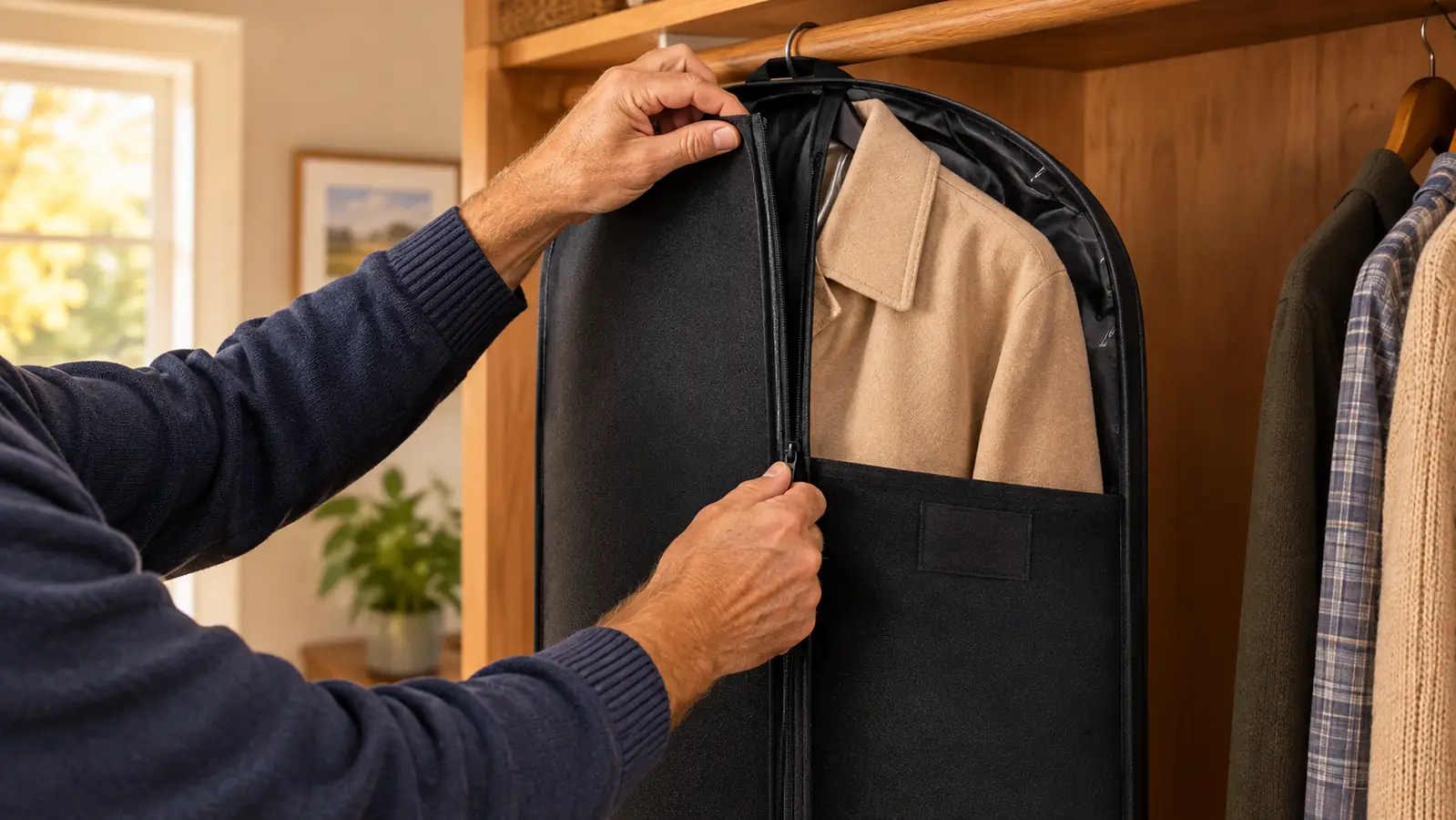
The first thing the SAY HO UM bag does better is breathe. The listing describes the 600D polyester as 100 percent breathable, and that single word is the most useful thing on the page for anyone keeping robes in a warm building. Plastic film does not breathe. Whatever moisture is left in a robe when it goes into the bag stays against the robe, and over a summer that is how you get the close, musty smell that greets you in September. The fabric bag lets air move through it. It is also described as water resistant, which matters if a ceiling leak finds the closet or if someone leans a damp umbrella against the rod on a rainy Wednesday.
The second thing is the shape. The bag measures 24 inches long, 5 inches wide and 60 inches tall, and the listing says it fits garments from 54 to 59 inches. That 5 inch gusset is the part choir directors underestimate. A robe on a hanger needs room at the shoulders or the sleeves fold back against the body and the front hem takes a crease that turns up right across the chest during the processional. The zipper closure means you hang the robe first and close the bag around it. You are not wrestling a sleeve of plastic down over thirty robes on a Saturday morning, which is a job that sounds harmless until you have done it thirty times in a warm room.
The third thing is that it survives being handled. Polyester that heavy takes a rub against a closet rod, a hanger hook, a stack of hymnals and the corner of a rolling cart. The listing notes it suits wool, fur, leather and formal pieces, and a church closet is exactly that mix, robes in one section and a few good coats for the winter service in another. I have repaired plenty of plastic in my time. I have not once had to repair a fabric bag, and after enough seasons that stops being a coincidence and starts being the point.
I measured our longest robe once, out of curiosity, and it hung at 57 inches from the hook to the hem. That sits inside the 54 to 59 inch range the listing gives, but it is well past the bottom of the plastic covers we had been using. For a season and a half the hem of that robe hung out below the plastic into open air, and every time I pulled it out there was a gray line of closet dust right across the bottom six inches. I washed that hem more often than any other part of any robe in the closet and I could not understand why until I set a tape measure next to it. Nobody in the choir had done anything wrong. The cover was simply shorter than the garment.
I have taped plastic bags back together an hour before a Christmas service. I have never once had to repair a fabric one.
Where the Plastic Gown Bag Wins
Now the honest part. A plastic gown bag is free, and free is a real word in a church budget. When the robe committee has thirty robes to cover and the money is already spoken for, nobody has to approve a decision that costs nothing. If a robe is being lent to a visitor for a single Sunday, or shipped to a member who moved away, plastic is the correct answer. You are not going to send a good fabric bag out the door with a rental and hope it comes back.
It also wins two smaller arguments. First, you can see through it. In a closet with thirty robes, being able to spot the one you need from the doorway without unzipping anything saves real time on a Saturday rehearsal when six people are waiting on you. Second, it disappears when it is empty. A drawer of flattened plastic takes up no rod space at all, and in a fellowship hall where the rod is already crowded and the closet doubles as a coat room in December, that counts for something. If your only real complaint is closet real estate, the plastic bag is not the enemy, and I would not pretend otherwise to make a nicer bag look better than it is.
See the bag that survives a Florida summer in a robe closet
The SAY HO UM Luxury Storage Garment Bag is 60 inches long with a 5 inch gusset, breathable 600D polyester, and a zipper closure. Rated 4.6 from nearly 2,000 buyers. Check today's price before the next robe Sunday.
Amazon Check Today's Price on Amazon →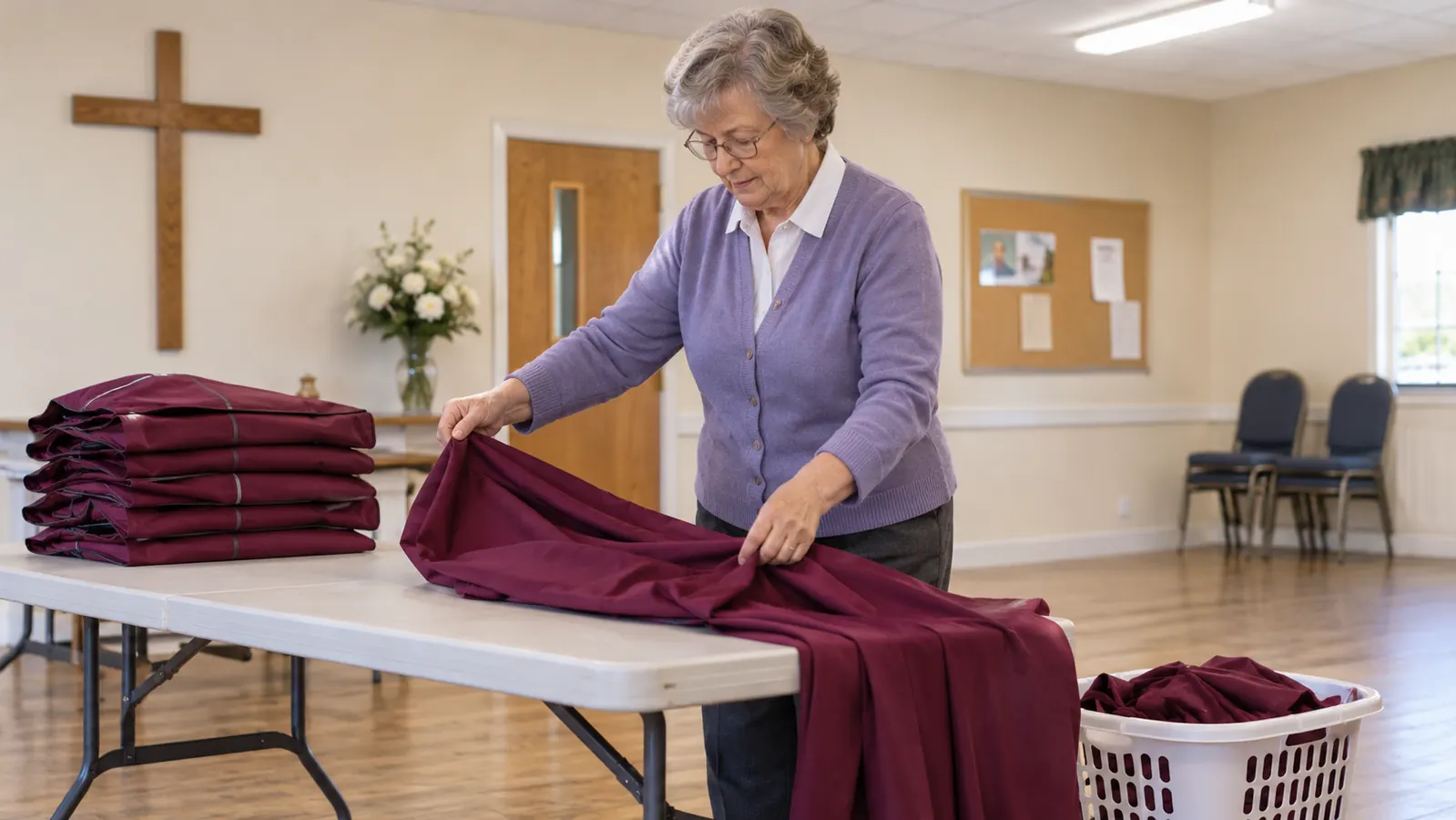
The Humidity Question Nobody Warns You About
Here is the piece I wish somebody had told me fifteen years ago. A robe that has just been worn for a full service is not dry. Under sanctuary lights in July, an adult choir member can finish a two hour service with the back of the robe damp, and the instinct is to get it on the hanger and into the bag so the closet looks tidy before everyone goes home. That instinct is what causes most of the damage I see. A sealed plastic bag turns a slightly damp robe into a closed container, and the closet does the rest of the work for you.
Whatever bag you use, the sequence should be the same. Hang the robe in open air in the fellowship hall for an hour or two first, then cover it. A breathable bag gives you some margin for error if the robe goes in a little early. A plastic bag gives you none, and it will not tell you so until weeks later. That is the whole argument in one sentence, and it is why I stopped buying the cheapest cover I could find and started paying attention to what the fabric was made of and whether air could move through it.
A July morning service here runs about two hours, and by the second hymn the back of a robe feels cool and damp through a shirt. In 2019 I put the whole alto section away wet after a summer service because we were already late for a fellowship dinner and I wanted the closet to look finished. I hung them, I bagged them, and I shut that door for six weeks. When we opened it in August to get ready for the fall, the smell came out ahead of the robes. We hung all thirty in the fellowship hall with two box fans running for three days, and most of them came back fine. Two did not, and both of those had been sealed in the tightest of the plastic. I have not made that mistake a second time, and I now keep a folding drying rack behind the door so there is never an excuse.
Who Should Buy Which
Buy the SAY HO UM bag if your robe lives in a closet for most of the year, if the closet sits in a warm or humid building, if the robes are shared and handled by different people every week, or if you are the one who ends up fixing things. Start with the ten or twelve that see the most wear, the ones that come out for every Sunday and go back in the same afternoon, and then work through the rest of the rod as the budget allows. One per robe is the goal. A closet half covered in fabric is already better off than a closet fully covered in film, and you can get there a month at a time.
Stay with plastic gown bags if you are transporting robes rather than storing them, if you are covering a robe for one week between services, or if the money genuinely is not there this year. There is no shame in it and no robe has ever been ruined by a plastic bag on a Tuesday. What ruins robes is a plastic bag in July that nobody opens until September. If that is the situation in your closet, that is the thing to fix first, and a breathable fabric bag is the simplest way to fix it. If you cannot do the whole closet at once, do the good vestments and the Christmas pieces, and let the everyday robes wait until the next quarter.
Give the robes a cover that can breathe until September
Sixty inches long, a 5 inch gusset for the shoulders, breathable polyester, and a zipper closure. The robe goes on the hanger first, then the bag closes around it.
Amazon Check Today's Price on Amazon →