
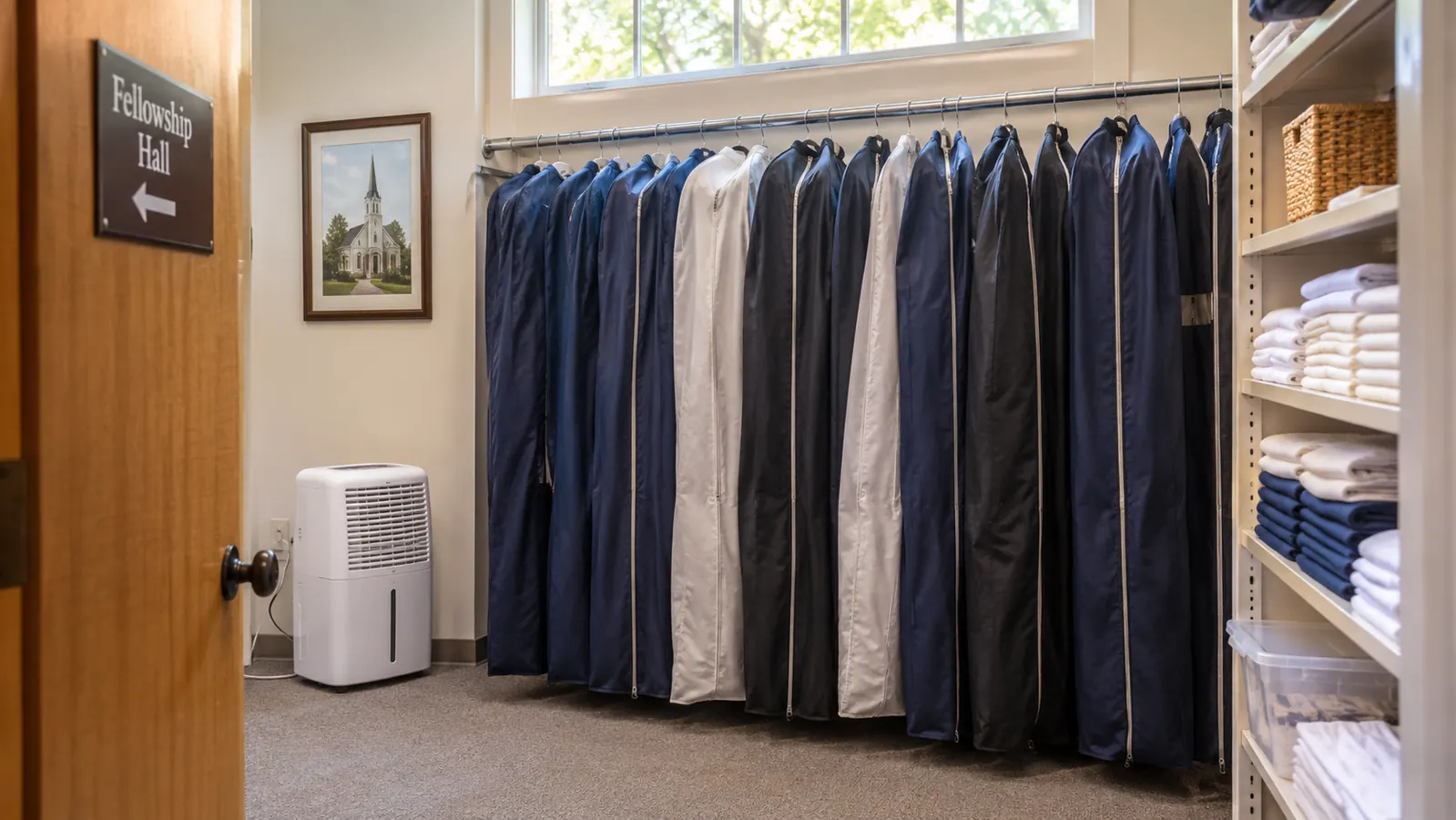
The robe closet at our church is a narrow room off the fellowship hall with one rod, two shelves, and a dehumidifier that runs from May to October. For years our thirty choir robes hung in there inside the thin plastic bags they came home from the cleaners in. Every August I would pull one down and find the shoulders pressed into hard ridges that no amount of steaming could relax before the first Sunday of the new season, and every August I would say the same thing to nobody in particular, which is that we are storing good wool in bad plastic.
My name is Gloria Pettaway. I am sixty-three, I sing alto in the Sanctuary Choir at Greater Mount Zion in West Palm Beach, and I am the volunteer wardrobe coordinator, which is a polite way of saying I am the one who washes, hems, labels and frets over thirty robes and the people inside them. Two summers ago the robe committee finally set aside a little money for proper storage. The first thing I ordered was one SAY HO UM Luxury Storage Garment Bag, the sixty inch one with the five inch gusset. I bought a single bag before I bought any of the rest, which is a habit I picked up after too many committee purchases that looked fine in a catalog and gave out by November.
The Quick Verdict
The first storage bag I have used that keeps a fifty-nine inch robe off the floor and still lets the fabric breathe. The zipper takes two hands and the bag will not iron out a bad shoulder, but after two years of Sundays it has not torn, split or gone musty.
Amazon Check Today's Price →Buy One Bag Before You Buy Thirty
That is exactly what I did with the SAY HO UM bag. Hang your longest robe in it for a month, then check the shoulders, the hem and the smell before the committee commits to a whole closet.
Amazon Check Today's Price on Amazon →How I've Used It
The test robe belonged to our tallest tenor. Fifty-nine inches from the shoulder seam to the hem, and the worst offender in all the plastic-bag years. I hung it in the SAY HO UM bag in June, put the bag back on the rod in the closet, and left it alone for a month. When I unzipped it in July, the creases across the back had relaxed. Nothing dramatic. The robe simply hung the way a robe is supposed to hang, with air moving around it instead of a bag pressed flat against it.
Before the bags, I tried the things people suggest. Cedar blocks in the corners of the closet, which smelled lovely for about six weeks and then just sat there. Lavender sachets pinned inside the plastic bags, which made the robes smell like a drawer. A second dehumidifier, which helped the room and did nothing for the inside of a sealed plastic bag. I also looked into a rolling rack, which would have eaten the only floor space in that closet and still left the robes uncovered. None of it was wrong. None of it kept a robe from pressing against itself for three months.
By August I had ordered enough for the whole Sanctuary Choir, then a few extra for the youth robes and the two spare vestments we keep for guest preachers. The bags are long enough that a robe hangs full length without doubling over at the hem, which matters more than I expected. A hem folded back on itself for three months will hold that fold all through Advent.
Since then the closet runs on a simple routine. Every robe goes back in its own bag after the Sunday service, zipped, on the rod, with a small tag on the hanger so nobody has to open four bags looking for the one with the short hem. Twice a year I take them all out, air them on the long table in the fellowship hall, and check seams, hems and hangers.
That is the whole system. It takes an afternoon in January and an afternoon in July, and it has replaced about four panicked weeknights a year, the ones where somebody calls me on Friday because their robe is creased, or missing, or has a hem coming down two inches from the floor. I am not going to pretend a garment bag fixed all of that. It fixed the creases and the smell, which was most of it.
What Sixty Inches Actually Covers
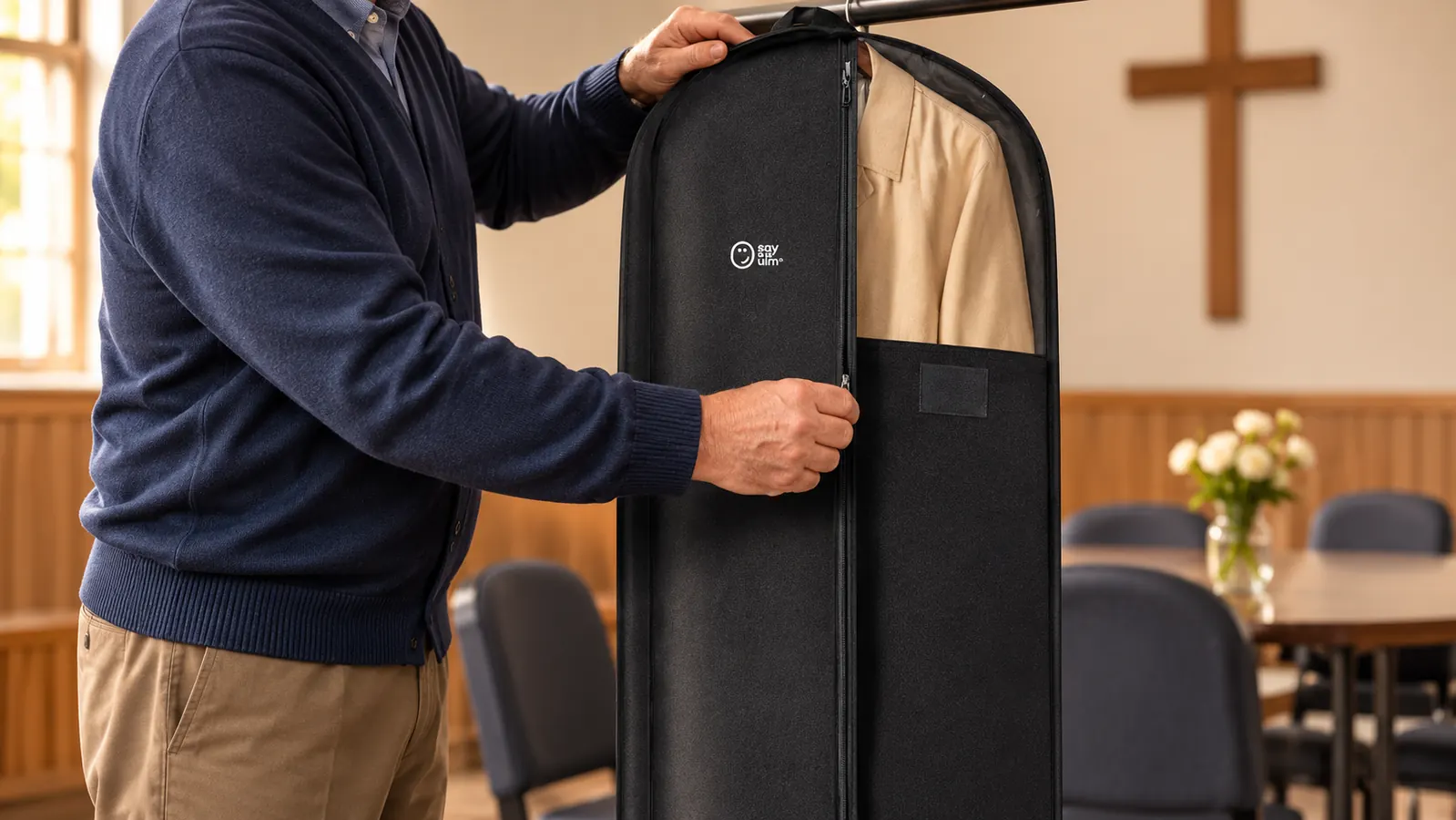
The bag is sixty inches from top to bottom with a five inch gusset, which is the depth that lets a robe hang without being squashed flat against itself. Our robes run from fifty-four to fifty-nine inches, and the listing says the bag is built for garments in that range. That matched what I found in the closet. The fifty-nine inch robe clears the bottom with room to spare, and the fifty-four inch robes do not pool in the base.
I measured on a Tuesday afternoon with a cloth tape and a clipboard, which sounds more official than it was. Thirty robes, shoulder seam to hem, written down by size. The shortest was a youth robe at forty-eight inches and the longest was the tenor's fifty-nine. What I found was that a robe shorter than about fifty inches sits in the bottom of this bag with a lot of empty fabric above it, which is not a problem for the robe, but it does mean a small choir with short robes is paying for length it does not use. Measure first. It takes twenty minutes and saves an argument.
The gusset is the part people underestimate. A flat bag holds a robe the way a book holds a pressed flower. Five inches of depth means the sleeves and the front panels sit beside each other rather than on top of each other, and the shoulders keep their shape. If your choir wears a stole or a hood, you will notice it the first time you open the bag in September and the stole has not left a permanent line across the chest.
I measured for the taller singers before I ordered, because our tenor is not the tallest person who will ever walk into that choir loft. Fifty-nine inches is the top of the range the bag is built for, and anything longer will touch the bottom. If your choir has a six foot four soprano in a floor length robe, measure the robe, not the person, and order accordingly.
What the bag does not do is compress. These are storage bags, not shipping cases. If you are moving thirty robes across town in the back of a pickup, you still need a rack or a box. The bag protects a robe that is hanging. That is the job, and it does that job well.
Breathability, and Why Florida Made Me Care
Our sanctuary gets warm under the lights by the second service, and the closet shares a wall with the kitchen. In the plastic-bag years I fought a smell I can only describe as closed. Not mildew exactly, just a robe that had been breathing its own air since Easter. The SAY HO UM bag is made from a breathable 600D polyester, so air moves through the fabric instead of sitting inside it.
Within a season the smell was gone. I am not going to tell you a garment bag deodorizes wool, because it does not. What it does is stop trapping the humidity that comes off a robe after a warm service. The material is also water resistant, which I tested by accident when a pipe above the closet dripped during a summer storm. The robe inside stayed dry. The bag took the water and dried out on the rod.
The July inspection is where I judge the smell question now. I take four bags off the rod at random, unzip them on the long table, and put my face right into the shoulders. Two summers ago that was a punishment. This past July the worst I found was a robe that needed airing because it had gone in slightly damp in May, which was my fault and not the bag's. I wrote the date on the tag that time so I would know. That is the level of record keeping a robe closet gets.
One honest note. Breathable does not mean you can hang a damp robe in it and forget it. If a robe comes off a singer who has been under lights for two hours, it goes on the wooden rack in the hall overnight first, then into the bag the next morning. The bag gives you air circulation. It does not give you a dryer.
The other thing breathability bought me was time. Robes that used to come out of storage needing a steam and a rest are wearable straight off the rod now. On a Saturday night before a big service, that is worth more than any feature printed on a label.
The Zipper Is the Part You Will Curse
Here is my main complaint, and it is small, and it will annoy you at exactly the wrong moment. The bag closes with a zipper, and that zipper wants two hands. One hand holds the top of the bag steady while the other pulls. If you try it one handed while holding a robe by the shoulder, you will fight it, and you will do this on a Sunday morning when the processional starts in ten minutes.
The second thing is that a zippered bag shows you everything you did wrong. A hem that is a half inch off. A sleeve that got folded instead of hung. A hanger too thick for the shoulders. In a plastic bag you never saw any of it. Here you see it, which means I now catch small problems in August instead of the morning of the Christmas program.
Neither of those is a defect. The zipper has not split, jammed or lost a tooth in two years of weekly use, and it has been opened and closed by about a dozen volunteers, some of whom are not gentle with anything they touch. It is just the one part of the bag you will have an opinion about.
My workaround is dull and it works. I hang the robe first, then zip it closed. Never the other way around, and never while balancing a hanger in my teeth.

How the Committee Bought Thirty of Them
I mention the buying because robe committees read a review like this one and then have to explain themselves at a business meeting. We did not buy thirty at once. We bought one, then ten, then the rest over the following year as the budget allowed. That staggered approach is worth copying, because a bag that works for the tallest tenor will still surprise you on a child's robe or a heavy winter vestment.
The vote happened on a Wednesday night in the fellowship hall, after the budget report and before the closing prayer, which is the slot where anything under a certain amount gets decided. I brought one bag, one creased robe, and the tag from the robe we had retired the year before. I hung the robe in the bag in front of them and let the meeting look at it. Ten minutes of conversation and the motion carried without a single question about the amount. The following January we did it again for the second batch.
The case I made was simple. We had already spent money on robes and were storing them in bags that came free with dry cleaning. A robe that has to be replaced every six or seven years because the shoulders are permanently creased costs the church more than a bag that lasts. Nobody argued with that. The bags have now outlasted two of the robes that went into them.
If your committee needs something to vote on, compare the bags against one replacement robe and let them do the arithmetic. That argument has worked in every church I have helped, and it works because it is true.
What I Liked
- Keeps a fifty-nine inch robe off the floor with room to spare
- Five inch gusset holds shoulders and stoles without pressing them flat
- Breathable 600D polyester ended the closed-in smell the plastic bags left behind
- Water resistant enough to shrug off a drip from the ceiling
- Zipper has survived two years of weekly use by a dozen volunteers
Where It Falls Short
- The zipper wants two hands, which is awkward on a Sunday morning
- No structure of its own, so it will not fix a badly shaped hanger
- Not a travel case. Robes still need a rack to move
When I unzipped it in July, the creases across the back had relaxed. Nothing dramatic. The robe simply hung the way a robe is supposed to hang.
Who This Is For
Choir directors, wardrobe volunteers, and anybody who keeps vestments, gowns, fur coats or long wool hanging for months at a time. If your robes live on a rod in a room that gets warm, and if you have ever spent a Saturday night steaming a shoulder crease, this bag solves that exact problem. It also suits a small choir of six or eight that cannot justify a rolling rack, and it suits a closet where one person does all the work and needs the system to be obvious to everybody else who opens that door.
Who Should Skip It
Skip it if you need to move robes rather than store them, because a soft bag is not a shipping case and will not protect a robe in the back of a van. Skip it if every robe in your closet is under fifty inches and you would rather have something compact, since sixty inches of bag on a short robe is more bag than you need. And skip it if you are hoping a bag will press out wrinkles. It prevents creases. It does not remove them.
One Bad Summer Is All It Takes to Set a Crease
Start with a single SAY HO UM bag for the longest robe in the closet. Check it in a month. Then decide about the other twenty-nine.
Amazon Check Today's Price on Amazon →