
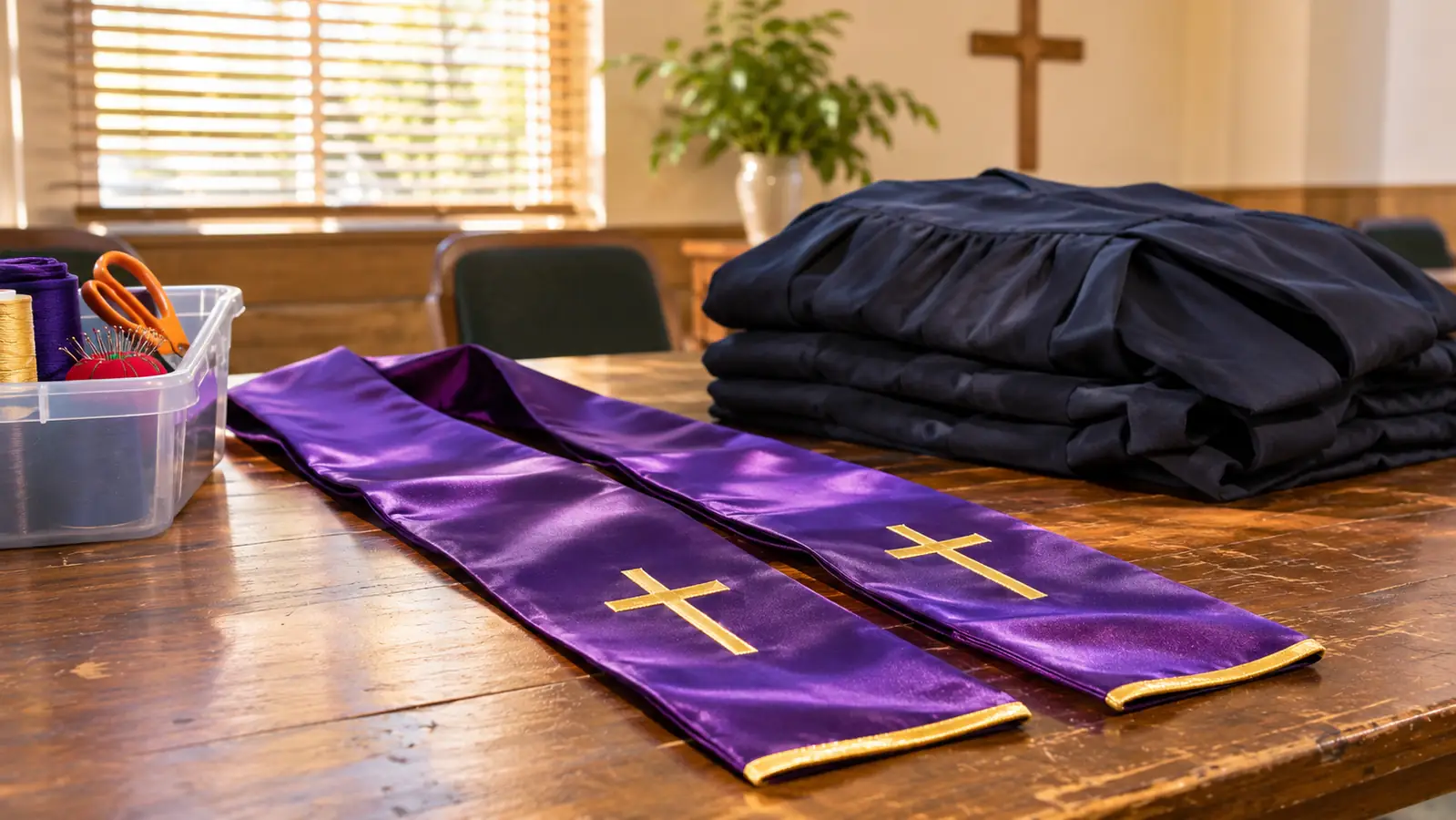
The first time our robe committee ordered stoles without seeing them in person, we bought forty. Thirty went into the closet. Ten went home with me to be fixed. That was nine years ago and I still run the robe closet at Greater Mount Zion, so I have made most of the mistakes a choir wardrobe volunteer can make, and I have made them in Florida heat with a sanctuary full of people watching.
So when I tell you about the CLERKMANS Choir Stole with Crosses, understand that I am not going to hand you a brochure. I am going to tell you what the fabric does after six washings, what the size means in practice, where it disappoints, and who should spend their money somewhere else. This is the honest version, the one I wish somebody had handed me before I ordered forty of anything.
The Quick Verdict
A solid, well-priced satin stole that photographs beautifully and holds up to a volunteer choir's schedule, as long as you order size generously and plan to steam it before Easter.
Amazon Check Today's Price →See what the current price looks like for the whole loft
If you are outfitting a choir rather than one singer, the per-piece price matters more than anything else on this page. Check the listing before you build the order.
Amazon Check Today's Price on Amazon →What I Actually Did With It, and For How Long
I ordered two stoles from CLERKMANS to start. That is the rule I follow now after the forty-stole disaster: buy two, live with them for a month, then talk about a bulk order. One went to our soprano section leader, who is a stickler about how things hang. The other stayed with me for the robe closet, which means it got tried on by eleven different people in a single Sunday, folded, unfolded, and carried in a tote bag to a funeral service across town.
We used those two stoles on rotation from late January through our spring concert in May, then daily through the Easter season. Then, because I am not sentimental about testing, they went into the washing machine with the rest of the robes. That is roughly five months of real use and four wash cycles before I felt like I knew what I was looking at. The first Sunday we wore them was February 9, and I stood at the back of the loft watching both stoles instead of singing, which my section leader noticed and mentioned to me afterward. By the second verse I had stopped worrying about the drape and started worrying about my own alto line. The funeral was in March, at a chapel across town with no rail and hard chairs, and the stole rode in a tote bag wedged between a hymnal and a thermos. It came out with two fold lines and steamed flat in under a minute in the ladies' room with the travel steamer I keep in the car.
What I was looking for, specifically: does the satin crease into a permanent map of every fold it sat in, does the cross motif hold its edges after washing, does the size run true enough that I can order from a list without measuring every single singer, and does it survive being worn over a robe in a sanctuary that hits eighty-five degrees by the second hymn.
The Fabric Question, Answered Plainly
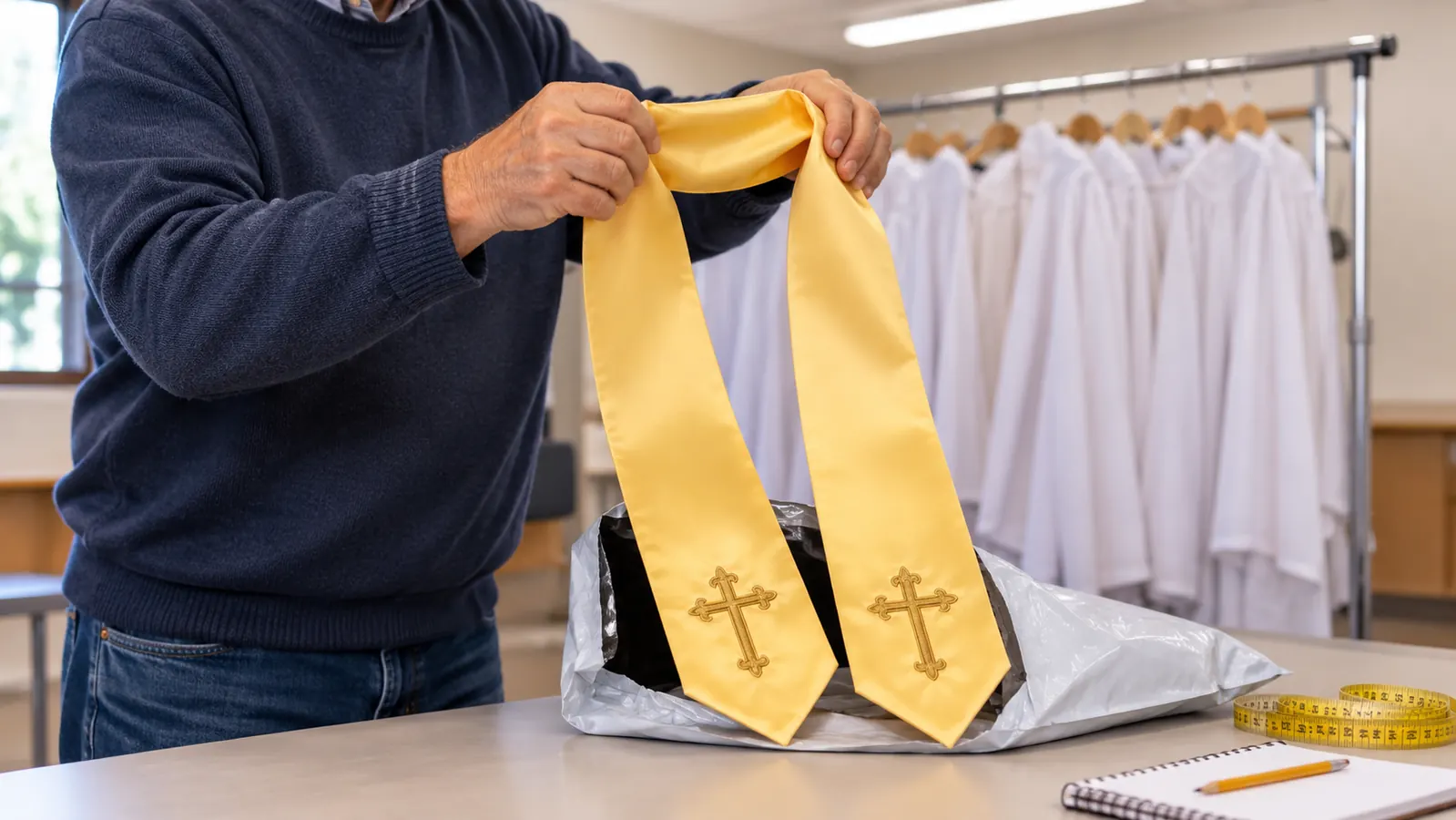
The listing says satin, and satin is one of those words that tells you almost nothing, because satin describes a weave, not a fiber. In practice, this stole has that smooth, light-catching face that reads as dressy from the third row, which is exactly where the congregation sits. It is not stiff. It drapes, which is what you want over a robe because a stiff stole stands away from the shoulder and looks like a sandwich board by the time you reach the benediction.
On the other hand, satin with a sheen shows every wrinkle, and this one is no exception. If you pull it out of a plastic bag on Sunday morning and drape it on, you will see fold lines. That is not a defect. That is the fabric doing what satin does. I keep a hand steamer in the robe closet and forty seconds per stole fixes it. If your choir has nobody willing to own a steamer, budget for that reality. The week after Easter our steamer quit on a Sunday morning with nine stoles still in the bag. I pressed two of them at home on the lowest setting through a thin cotton cloth, and they came out fine, but it took twenty minutes I did not have and I would not build a Sunday routine around an iron. Two of the nine went out wrinkled that morning, and I let them, because the processional waits for nobody.
Heat is the other thing. In a Florida sanctuary in July, satin is not the breathable choice a cotton or a linen blend would be. It is not unbearable, and the stole is a narrow band rather than a full garment, so it sits over the robe and not against the whole torso. But I would not tell you this is a cooling fabric. On our hottest Sunday of the year, two of my altos took theirs off during the sermon. They put them back on for the closing hymn. Nobody died. But you should know it.
Satin shows every wrinkle and does not breathe in a Florida July, and I still ordered more of it, because the drape and the finish are what the congregation actually sees.
The Cross Motif and How It Holds Up
The crosses are the reason most people click on this listing in the first place, so let me be specific about what happens to them over time. After four wash cycles, the motif on both of my test stoles is intact. No peeling, no lifting at the edges, no thread ends working loose. I turned them inside out, used cold water on a gentle cycle, and hung them to dry, which is what I would tell any choir to do with any decorated piece.
What I cannot promise you is what happens on the fiftieth wash. I have watched decorated pieces fail in year three, and I have watched them outlast the robe they were pinned to. The honest answer is that a decorated satin piece is a consumable, not an heirloom, and if you get five or six seasons out of a set you have done well. Plan your robe budget that way and you will never be surprised.
One practical note that has nothing to do with quality: the cross motif means the stole is doing liturgical work, so it fits a service where that is appropriate. If your choir sings a contemporary set in a room with a projection screen and no rail, this may be more formal than the room wants. That is not a flaw in the stole. It is a question of matching the piece to the service, and it is the kind of question a robe committee should ask before it orders forty of anything.
Sizing Is Where People Get Hurt
The listing gives one size word, Small, and this is the single most important thing I can tell you. Do not read that as a fit judgment about your singers. Read it as a dimension you need to check against the listing before you commit, because a stole is a hanging length, and the length is what determines whether it ends at the right place on the robe or flaps around the knees.
Here is how I handle it now. I measure one singer from the shoulder seam down to where I want the stole to end, I compare that to what the listing states, and then I decide. If you are ordering for a mixed adult choir with tall basses and petite sopranos, one size will not land identically on all thirty of them. That was true of every stole we have ever owned, from every seller. It is not a knock on CLERKMANS. It is arithmetic. Two seasons ago I measured twenty-eight singers on a legal pad, shoulder seam to the top of the knee, and the spread was eleven inches, from a soprano who is barely five feet to a bass who clears six-four. There is no single length that lands the same on both of them. I keep that pad in the closet and I pull it out every time we order anything that hangs, because a list of names without numbers has cost me more money than any fabric decision.
My advice: order two before you order thirty. Put them on your tallest singer and your shortest singer. Look at them under the sanctuary lights, not in the fellowship hall with the fluorescents on. Then order the rest. Two stoles and one extra week will save you a return shipping argument you do not want to have with a volunteer treasurer.
Order two, try them on the tallest and shortest singer, then decide
That is the whole method. It has never once let me down on a robe order, and it costs you almost nothing to run.
Amazon Check Today's Price on Amazon →What Nobody Tells You About Owning a Satin Stole
The care instructions matter more than the purchase. Cold water, gentle cycle, inside out, hang to dry, and never, ever put a decorated satin piece in a hot dryer. I have seen a well-meaning volunteer ruin a set of stoles in one afternoon because she wanted them dry before the evening service. If your choir has a rotation where stoles get washed between services, you need two sets, or you need to accept that they will be worn slightly damp. In Florida, they will dry on the line in an hour, so this is a smaller problem than it sounds, but plan for it.
Second thing nobody tells you: storage. Satin creases along whatever edge it is folded against, and if you stack twenty stoles in a bin from October to December, every one of them comes out with the same fold line down the middle. I hang ours now on a rolling rack in the closet with about two inches between them. That rack cost less than replacing one set of stoles, and it has paid for itself several times over. Before the rack we used a clear plastic bin under the folding table, and one December I opened it after two months and found the same crease down the center of every stole in the stack. I hung them on the rack, misted the creases with water from a spray bottle, and left them overnight. Most of it fell out. Not all of it. The rest needed the steamer, which is the answer to most stole problems.
Third: the weight of a stole on a robe collar. A satin stole is light enough that it does not drag a robe collar sideways, which is more than I can say for the heavier woven pieces we tried in 2019. Those pulled the robe off the shoulder of our smallest soprano every single time she raised her hands. Light is good. Write that down before your committee gets excited about a heavier fabric.

Pros and Cons, Without the Sales Language
What I Liked
- Smooth satin face reads as dressy from the congregation, which is the only distance that matters
- Drapes instead of standing away from the shoulder, so it looks right over a robe collar
- Cross motif survived four wash cycles with no peeling or lifted edges
- Light enough that it does not pull a robe off the shoulder during a raised-hand refrain
- Photographs and video-record well under warm sanctuary light
Where It Falls Short
- Satin creases visibly and needs steaming before a service if it has been folded in storage
- Not a breathable fabric, and it shows in a hot sanctuary in summer
- One size word on the listing means you must check the stated length against your singers before a bulk order
- Decorated satin is a consumable, not a lifetime piece; plan for a five to six season life
How It Compares to a Plain Satin Stole
We also own plain satin stoles with no cross motif, and the honest comparison is simple. The plain version is more flexible: it works for a contemporary service, a funeral, a community event, and a room with no rail. The cross version does one job and does it well. If your choir sings one traditional service a week and the stole is meant to say something about the season and the room, the crosses earn their place. If your choir is all over the map stylistically, buy plain and put your money into better robes.
Price-wise they sit in the same neighborhood, so this is not a budget decision. It is a decision about what the piece is for. I keep both in the closet. The crosses come out for Sunday morning and the high services. The plain ones go to funerals and out-of-building engagements, where a cross motif in a hospital chapel or a graveside service can feel like more than the moment wants.
Who This Is For
This stole is for a choir that sings a traditional service in a sanctuary with a rail, where the visual language of the room already includes vestments and paraments. It is for the wardrobe volunteer who is willing to own a hand steamer and a garment rack, because those two items are what separate a good-looking loft from a wrinkled one. It is for a church that would rather buy a good piece at a fair price and replace it in six years than buy a cheap piece and replace it in two.
It is also, frankly, for the choir that is tired of looking uneven. A matched set of stoles does more for the look of a loft than almost anything else you can buy, because it turns thirty individuals into one visual unit. I have watched a congregation sit up straighter when a choir walks in matched. That is not a small thing on a Sunday morning.
Who Should Skip It
Skip it if your sanctuary runs hot and your singers are already miserable in robes. Skip it if your choir sings in a modern room where vestments would look out of place, because a cross motif in that setting creates a conversation your committee does not want to have. Skip it if nobody in your church will take responsibility for steaming, hanging, and washing a decorated piece, because satin punishes neglect faster than any fabric we own.
And skip it if your budget only stretches to one set and you cannot buy a spare. Two stoles in reserve is not extravagance. It is the difference between a smooth Easter and a scramble in the hallway fifteen minutes before the processional. I learned that the hard way, and I would rather you did not.
One more honest word about the brand. CLERKMANS makes a good piece here, and I have recommended it to two other churches in our area. That does not mean every item in their catalog suits every choir. It means this particular stole, at this particular price, with these particular limits, is a reasonable buy for the kind of choir I described above. Read the listing's stated length and size before you order, because that is where the disappointment lives, not in the fabric.
If your loft needs to look matched by Easter, start with two
Buy a pair, try them on your tallest and shortest singer under sanctuary light, and let the fabric tell you the rest. That is how a robe closet stays out of trouble.
Amazon Check Today's Price on Amazon →