

On the Sunday after Easter, I stood in the robe closet at Greater Mount Zion with two stoles in my hands and a decision to make for the fall. One was the CLERKMANS Cross Stole, a satin stole with crosses built into the design. The other was a plain satin choir stole, the kind we have borrowed and mended for years. I am Gloria Pettaway, I have sung alto in this choir for more than thirty years, and I am the volunteer wardrobe coordinator. That means I wash, press, label and find the missing stole ten minutes before the processional. So when I say I compared these two, I do not mean I read two listings. I mean I put both in front of the choir and listened to thirty voices tell me what they thought.
Here is the short answer. If your choir wants the cross to read from the pews and you do not trust a box of loose pins, the CLERKMANS stole is the simpler piece to manage. If your robes already carry a cross, or your committee changes the look every season, a plain satin stole is more flexible. Neither is a bad choice. What follows is the reasoning I would give at my kitchen table, including the places where the plain stole wins.
| CLERKMANS Cross Stole | Plain Satin Choir Stole | |
|---|---|---|
| First impression from the pews | The cross repeats across the section and gives the choir one visual rhythm. | The plain surface keeps the look quiet and lets faces carry the section. |
| Cross detail | Crosses are part of the stole, so there is no separate pin box to manage. | No cross detail, so you add pins, a pendant or nothing at all. |
| Packing and storage | The cross area needs to be laid flat so it does not take a crease in the box. | A plain surface folds and stacks with less fuss in the closet. |
| Wardrobe flexibility | Best for services where a cross on the stole is the look you want. | Easier to change the look with pins, a brooch or a seasonal addition. |
| Fabric | Satin, as listed, with the sheen that reads under sanctuary lights. | Satin too, which is why the two look closer than you might expect. |
| Sizing | The listing calls the size small, so measure before you order for a tall singer. | Plain stoles vary by maker, so sizing is a conversation with each seller. |
| Choir unity | Thirty matching crosses make the section look deliberate from the back row. | Thirty plain stoles let the faces and the robe line do the work. |
| Maintenance in a busy closet | The cross design is one more area to check when a piece comes back. | Fewer details to inspect, which matters when you maintain a closet for thirty people. |
| Ordering for a group | One listing, one design, easier to keep the section consistent. | Many sellers and styles, which can be good or a headache. |
Where the CLERKMANS Cross Stole Wins
The CLERKMANS stole does one thing a plain stole cannot do on its own: it puts the cross in the same place on every singer without asking anyone to own a pin box. In a choir of thirty, that matters more than it sounds. We have had Sundays where three singers wore a pin and the rest forgot, and from the pews it looked like a mistake rather than a choice. The cross is part of the piece, so the section reads as one body. The listing is for unisex adults, which helps when the tenors and the sopranos are sharing a closet, and the satin has the sheen that shows up under sanctuary lights without needing a spotlight.
I also like that the piece is one design. When you order for a group, one listing means one look, one label and one conversation with the seller. The listing calls the size small, so I would still measure the first singer before I ordered thirty. The rating sits at 4.5 stars from 218 reviews, which is not a promise that it will fit every body in the loft, but it is a track record. For the high services, Christmas and Easter, the CLERKMANS stole gives us a unified look without adding another task to the morning.

Where the Plain Satin Choir Stole Wins
A plain satin stole wins on storage and flexibility, and I will not pretend otherwise. It folds flat, stacks in a drawer and does not ask me to protect a cross area from creases. In a small fellowship hall closet, that is real. It is also the piece I reach for when the robe already has a cross on the chest. Two crosses in the same place can look crowded from the pews, and a plain stole lets the robe do that work. If the choir changes its look with pins, a brooch or a seasonal addition, the plain piece is the better base.
Plain satin is also easier to replace and easier to borrow. We have had years when the budget only covered a few new pieces, and a plain stole could match what we already owned. The CLERKMANS piece is a commitment to one look. That is good for unity and bad for flexibility. If your committee likes to change the wardrobe every season, plain satin will save you an argument.
See the CLERKMANS Cross Stole on Amazon
One design, crosses built in, and no pin box to chase on Sunday morning.
Amazon See the CLERKMANS Cross Stole on Amazon →How I Compared Them
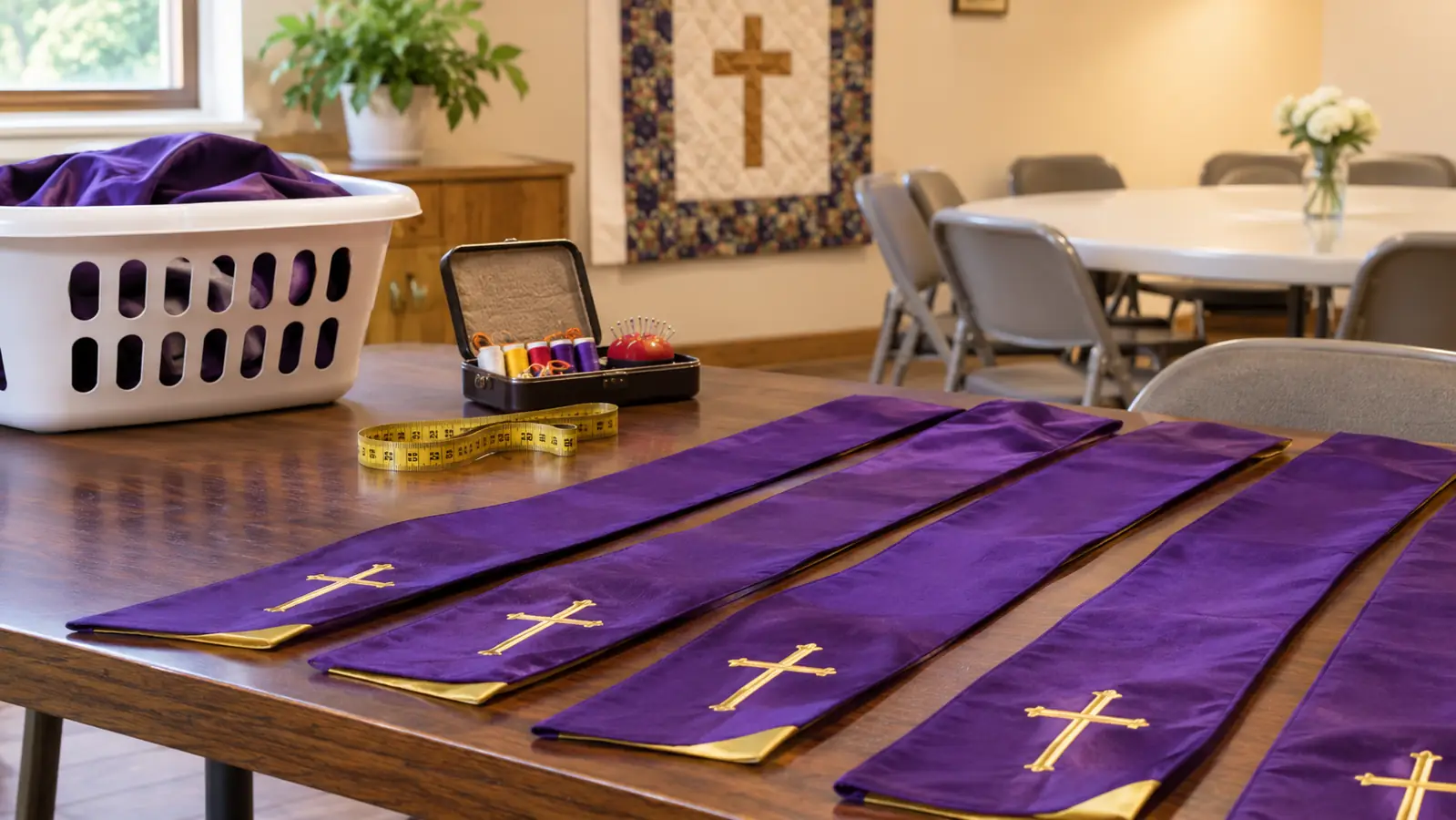
I did not run a lab test. I ran a choir. I laid both stoles on the folding table in the fellowship hall, under the fluorescent light and then under the sanctuary lights, and I asked singers to walk up the risers and stand through a rehearsal. I looked at four things: how the piece reads from the pews, how it sits over a robe, how it handles storage, and how it holds up in our closet. I also asked the tenors, who are the honest ones.
The first thing I noticed is that satin is satin. Both pieces have the same family of shine, so the difference is not the fabric alone. The difference is the cross and the work it saves. A plain stole can look just as polished. It just asks you to decide what goes on it. That is the whole comparison in one sentence, and the rest is detail.
The second thing I noticed is that a stole is a layer. In our Florida sanctuary, the lights are warm and the humidity is real. I would not tell you that one satin piece is cool and the other is hot. I would tell you to fit the piece so it sits flat and does not bunch at the neck, because bunching is what makes a singer miserable by the second hymn. We checked that on three body types before we made a decision.
Fabric, Light and the Florida Heat
Satin is not the fabric I would choose for a July picnic, and I will not pretend it is. But a stole is not a shirt. It is a layer over a robe, worn for a service, and the sanctuary lights do most of the work. The CLERKMANS piece has the sheen that catches those lights, and the cross gives the eye a place to land. A plain stole catches the same light and sends it back with nothing to break it up.
In the heat, fit matters more than the label. A stole that sits close at the neck and hangs straight will feel better than one that twists. We checked the drape on the risers, where the air moves less. Both pieces passed that test when they were the right size. The listing calls the CLERKMANS size small, so if your choir runs tall, order one and try it before the group order. That is not a flaw. It is just the reality of buying a wearable for thirty people from one listing.
I also think about how the piece looks from the back row. From the pews, a choir is a row of shoulders, faces and one repeating shape. The cross gives that shape a rhythm. A plain stole gives you a clean line and lets the faces carry the section. Both work. The question is which one your sanctuary needs on a Sunday morning.
A stole is not a costume. It is the piece that tells the congregation who is serving that morning, and it has to survive the closet between Sundays.
What the Crosses Do for a Choir
A cross on a stole is a small thing that does a large job. It tells the congregation that this is a set-apart group without a word being spoken. It also gives the choir a visual center when they are standing in a long line. The CLERKMANS piece puts that center on every singer at once. With a plain stole, you can add a pin, but then you own thirty pins, and someone has to count them.
I have nothing against a plain stole. I have sewn pins onto them and taken them off again. But the pin approach fails on the Sunday when the box is missing or a singer forgets. The CLERKMANS piece removes that failure point. For a volunteer choir, removing a failure point is worth more than a little flexibility.
Care, Storage and the Robe Closet
We hang stoles on padded hangers when we have the room and fold them flat when we do not. A plain satin stole folds into a stack and does not complain. The CLERKMANS piece needs a little more care around the cross area so it does not take a crease. We press satin through a cloth, and we do not rush it. I check the cross area for snags when a piece comes back. That is not a product flaw. It is the trade for a detail.
In our closet, every piece gets a label with the singer's name and a quick inspection. The plain stoles are faster to inspect. The CLERKMANS stoles take an extra minute because I look at the crosses. Over a season, that extra minute is real, but it is also the minute that keeps the piece looking right. If you do not have that minute, plain satin is the honest choice.
Storage is where the plain stole wins again. We stack plain stoles in a laundry basket when we are moving between services. I would not stack the CLERKMANS pieces that way. I would hang them or lay them flat in a box. That is a small thing until you are the one carrying the box.
What the Committee Asks Me
The first question is always about fit. The listing calls the CLERKMANS size small, so I tell the committee to order one and try it on a few singers before the group order. The second question is about the crosses. Will they line up? I check the first piece from the shoulder seam and order the rest from the same listing. That is the best I can do without seeing every piece in person.
The third question is about care. I tell them we treat satin like satin. We do not toss it in with the towels. We do not iron it hot. We hang it or fold it flat. That is true for both pieces. The difference is that the CLERKMANS piece has a detail I want to protect, and the plain piece does not.
The fourth question is the one nobody wants to ask: what if we change our minds? A plain stole is easier to change. The CLERKMANS piece is a look. If your committee is stable and your services are traditional, that is fine. If your committee changes every year, buy a few plain pieces and keep them as your base.
Who Should Buy Which
Buy the CLERKMANS Cross Stole if you want the cross to be part of the piece, if your choir wears plain robes, if you are ordering for a group and want one look, and if you are tired of pin boxes. It is also the better choice for Christmas and Easter, when the sanctuary is full and the choir needs to read as one body. Measure first, because the listing calls the size small, and order one before you commit the whole section.
Buy a plain satin stole if your robes already carry a cross, if your committee changes the look often, if your closet space is tight, or if you want to add your own pins or a brooch. It is also the better choice if you are matching stoles you already own. Plain satin is not a lesser piece. It is a different job. If I were starting a choir from nothing, I would buy the CLERKMANS for the high services and a few plain stoles for the ordinary Sundays.
Get the Cross Stole That Survives the Closet
The CLERKMANS Cross Stole gives the section one look and takes the pin box out of your Sunday morning.
Amazon See the CLERKMANS Cross Stole on Amazon →