
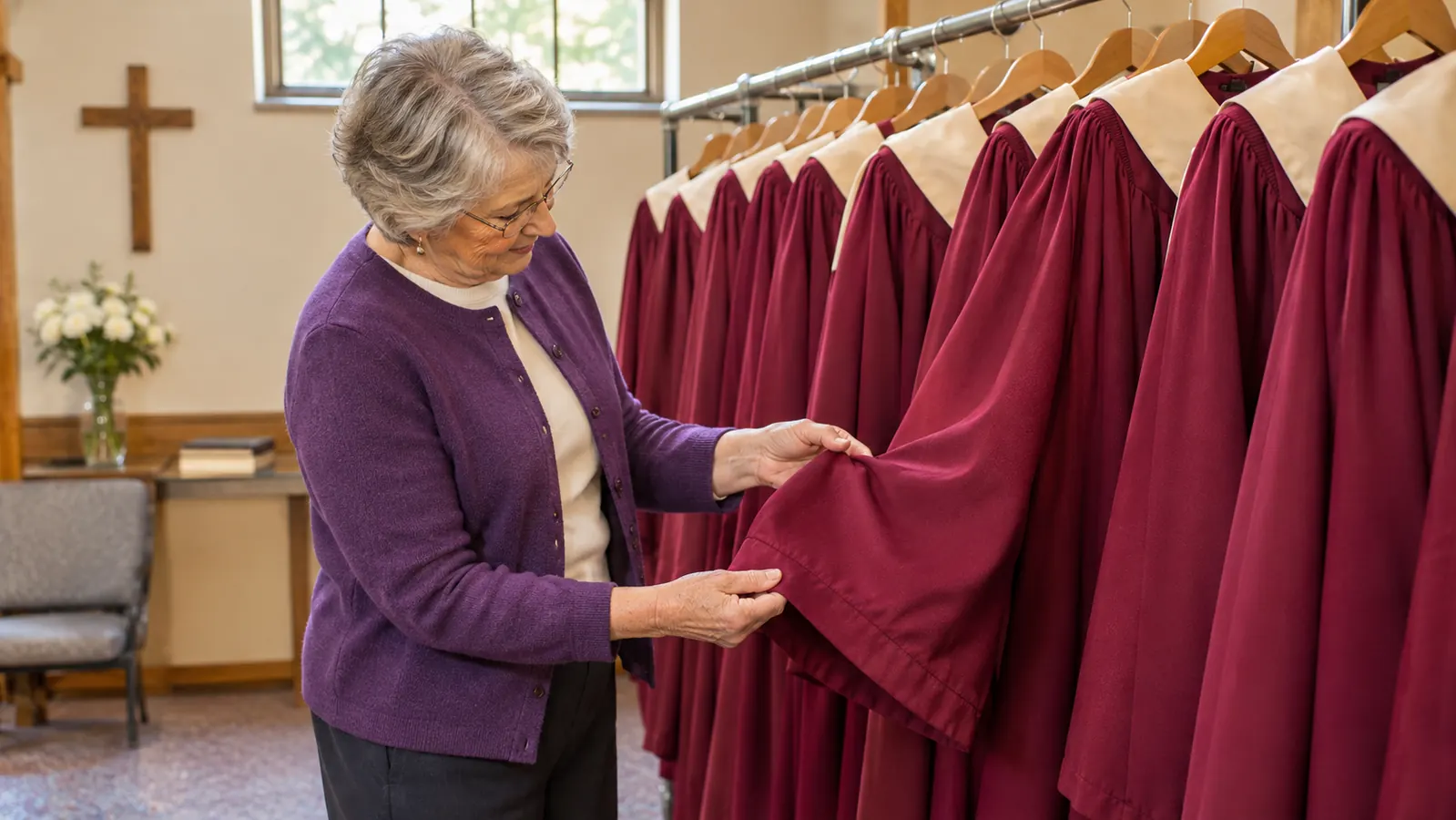
Three weeks before Easter, a box from GradPlaza landed on the fellowship hall table, and I did what I always do. I opened it in front of the whole robe committee so that nobody could say afterward that I had decided anything behind a closed door. That was the spring before last. Since then, our Sanctuary Choir has worn these robes through two Easter services, a Christmas Eve, one spring concert, and somewhere north of a hundred ordinary Sunday mornings. I have washed every one of them, hemmed four, taken in two, and driven across town to retrieve one from the back seat of a baritone's car where it had been living for a week.
So this is not a first impression dressed up as a review. This is the view from the closet, which is a different vantage point than the product page. What follows is what I would say to a robe committee before they vote on a line item: the parts of owning these that nobody mentions, the two things I still do not love after two years, and the reason we would order them again anyway.
The Quick Verdict
A genuinely light, machine washable robe that survives a volunteer choir's schedule. Size up, expect nothing in the box but the robe, and budget for a steamer before you budget for anything else.
Amazon Check Today's Price →Measure first, then order up one size. Here is the current GradPlaza listing.
The fit note on this page is not a formality. Take the shoulders and the chest on the person who will wear it, add room, and check the sizing against that number rather than a street size.
Amazon Check Today's Price on Amazon →What Nobody Tells You Before the Committee Votes
Start with the box. The listed included components field says Dress, singular, and that is exactly right. You get the robe and nothing else. No stole, no hood, no cap, no cover, no hanger. If your committee is comparing this against a robe that arrives with matching accessories, put those accessories in the budget separately or you will get to the Saturday before Easter and discover you are short. We already owned stoles from the previous set, so this was fine for us. It would not be fine for a church starting from nothing.
Second, the robe arrives folded, and polyester that has been folded inside a shipping bag for a week holds a crease like it is being paid by the hour. Lightweight fabric is not the same thing as wrinkle resistant fabric, and the listing never claims otherwise. We hung the first batch on the rail in the closet for four days and steamed the worst of the shoulder folds. If your choir walks in on Sunday looking like they slept in their robes, that is shipping, not the garment, and it is fixable. Buy a handheld steamer at the same time you buy the robes. Not later. Same time.
Third, the solid pattern is doing more work than you think. Solid means no contrasting trim, no piping, no panel down the front. What you see is a plain V-neck ceremonial gown at calf length, and that plainness is either the entire reason you are buying it or the reason your committee will be disappointed. Our sanctuary is warm and visually busy already. A plain robe calms that down. A robe with trim would fight it. But if your choir is used to a detailed robed look, this will read as plain to them, and plain is a heavy word in a committee meeting.

How Our Choir Has Actually Used It
Thirty voices is a strange number to dress. Tenors are hard on everything they own. Altos will tell you honestly whether something itches. Our size 48 covers the person it was ordered for without argument, and the loose fit means the robe hangs rather than clings, which matters more than it sounds like it should when you stand still for forty minutes under lights and then sit down for a sermon. Nobody has complained about the shoulders. In a volunteer choir, that is a headline.
Sunday mornings are the real test, not Easter. Easter has adrenaline in it. A Tuesday night rehearsal in July does not. The robe went on over street clothes, came off, went back on the hanger, got carried home by mistake, got brought back, got washed, got worn again. After two years of that, the fabric has softened rather than frayed. I have not thrown one away. I have not had one split at a seam. For a lightweight imported gown from GradPlaza that took a per-piece line item out of the music budget, that is the only report I really care about. Count the laundry if you want a number. Thirty robes, washed in rotation after every fourth Sunday plus every special service, works out to something near two hundred trips through the machine across the set. Two came back with a pulled thread at the pocket edge that I trimmed and sewed down in five minutes. That is the entire repair log. Nothing has faded in any way anyone would notice either, which surprised me more than it should have given how much sun comes through that fellowship hall window on a Wednesday afternoon.
We also use them for baptisms. The occasion field on the listing names baptism and christening alongside graduation, and while I would not buy a graduation gown for a baptism, a plain ceremonial gown is genuinely useful for a candidate who wants to be covered and comfortable going down into the water and coming back up. Ours are not the garments we keep set aside for that purpose, but two of them have been borrowed for it and both survived the afternoon.
The Fabric Question: Polyester, Weight, and a Warm Sanctuary
The material is polyester with a lightweight fabric weight class, and the listing is honest about both. What that means on a Sunday in West Palm Beach is that the robe does not hold heat the way a heavy gown does. Our sanctuary runs warm from June through September, and the front rows under the lights run warmer still. I have worn heavier robes in that loft and finished the service with a wet collar. In this one I finish the service warm but not wrung out. If your building is air conditioned to a meat locker, you will not notice either way. If it is not, you will notice. The hottest service we have sung in these was the second Sunday of last August. The thermostat in the narthex read 79 when we lined up, and the loft was warmer than that by the time the sermon started. I was uncomfortable. I was not soaked, and I did not have to peel the robe off my shoulders in the parking lot afterward, which is exactly what used to happen with the old set. That is a low bar for a garment to clear. It is the bar I actually measure robes against.
What lightweight does not mean is substantial. There is a drape you get with a heavier ceremonial gown that this garment does not have. It hangs, it moves, it photographs perfectly well from the third row, and it will not read as a heavy investment piece up close. If your church wants the weight and swing of a formal academic robe, this is not that, and no amount of steaming will make it be. That is not a flaw. It is a choice the maker made, and it is the same choice that keeps thirty volunteers comfortable in July.
The listing puts the robe at 0.35 kg, a bit under a pound. That number is most of the review in one line: it goes on, it moves, and nobody in the third row hears it coming.
One more fabric note that matters in a choir loft and never appears in a product description. Lightweight polyester and a live microphone are not friends. The fabric rustles when a singer shifts weight, and in a quiet sanctuary with a mic three feet away, that is audible. We learned to settle before the downbeat. If your choir fidgets, know that the fidgeting now has a soundtrack.
Sizing: Runs Slightly Small Is Not a Suggestion
The GradPlaza listing carries a fit-to-size sentiment of Runs Slightly Small, and I want to be plain with you about it. Believe it. The fit type is loose, so the robe is cut generously through the body, and people read the word loose and assume they can order their street size. Do not. Order up one. If the person is between sizes, or broad through the shoulders, order up two and take it in later. Taking in is a Tuesday afternoon with a sewing machine and a cup of coffee. Letting out is not possible, and it is not a conversation you want to have in the choir room. Here is the arithmetic we used. Measure the chest around the fullest part, add three inches so the robe hangs over a blouse or a buttoned shirt instead of pulling across it, then match that number to the size chart rather than to a dress size. Our alto who wears a 14 on a normal day measured into the size 48 with room left over. The soprano who is broad through the shoulders went one beyond that and had it taken in two inches at the side seam, and she has not mentioned the shoulders since.
Calf length is a gift on risers and a mild hazard on stairs. On the risers, a calf-length robe means nobody behind you is standing on your hem, which is the single most common robe problem I deal with in a given year. On the stairs up to the loft, it means you carry it. I watched a soprano take those stairs at a pace that suggested she had forgotten she was wearing a gown. She remembered at the bottom. Nothing tore, and I have stopped worrying about it.
The V-neck deserves a sentence because it is the part people actually see. It sits where it should and it does not gape when the wearer leans over to find a hymnal in the pew rack. That sounds like a low bar for a garment. It is not. I have pinned more necklines closed on a Sunday morning than I care to count, and I have not had to pin one of these.
What I Still Do Not Love
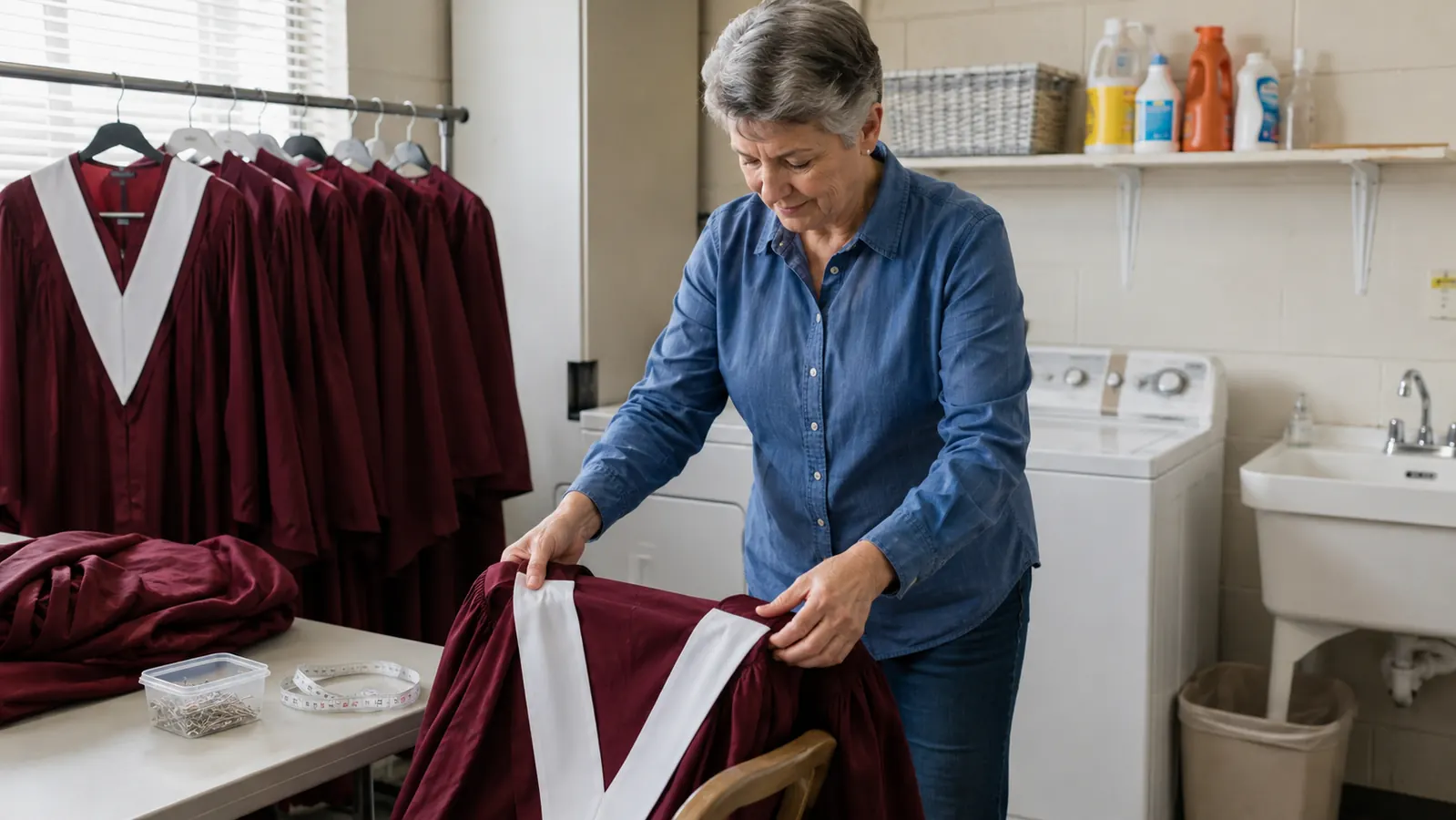
Two years in, two complaints stand. The first is that a solid, plain robe shows every crease it collects on the rail. There is nowhere for the eye to go, so a wrinkle in the back reads as a wrinkle in the back. A robe with trim hides that. This one does not. If your closet is a pipe rail in a fellowship hall with robes pressed against each other, plan on a steamer going over the worst of them on Saturday night. We do, and I have made peace with it, but I would rather your committee heard it from me than discovered it in April.
The second is that the loose cut has a limit. A robe that hangs this freely will also hang off whatever a member wears underneath it, and a bulky layer underneath shows in the line from the shoulder down. We ask the choir to wear something smooth under their robes, and we keep two spare undershirts in the closet for the people who forget. That is a wardrobe rule, not a design flaw, but the robe magnifies it more than a heavier fabric would.
Washing, Storage, and the Job Nobody Volunteers For
Machine wash is in the care instructions, and machine wash is what we do. Cold water, gentle cycle, hang to dry. I mean hang to dry. A lightweight polyester gown in a hot dryer is a gamble I am not willing to take with the church's money. We hang them on the rail in the fellowship hall closet overnight and they are dry by morning, even in Florida, even in August, because there is so little fabric to dry. One caution from experience. A helper put a single robe through the dryer on low for twenty minutes because she needed it that evening, and it came out stiff and creased enough that I had to steam it all over again before she could wear it. Nothing was ruined. We have not repeated the experiment. Hang to dry is not a suggestion in this house, and in this climate it costs you one overnight, no more.
Storage is where volunteer wardrobes fall apart. Robes go on whatever hanger is nearest, and whatever hanger is nearest is a wire one, and wire hangers leave a shoulder shape that no steamer will fix. We learned that the hard way in the first month. Twelve robes went onto the twelve wire hangers already in the closet, and by the second Sunday every one of them had two little points at the shoulder that showed from the front row. I replaced them all with wide wooden hangers from a discount store and the points were gone within a week. Buy proper hangers at the same time you buy the robes and treat it as part of the purchase. We keep a small labeled bin in the closet with safety pins, a measuring tape, a needle and thread, and the handheld steamer. The steamer has earned its place in there more than anything else.
What I Liked
- Lightweight polyester that stays wearable under warm sanctuary lights in summer
- Machine washable and quick to hang dry, which matters for a volunteer laundry rotation
- Loose cut hangs rather than clings, and the V-neck does not gape when leaning for a hymnal
- Calf length keeps hems off the risers and out from under the person behind you
- Solid, plain styling reads calm in a visually busy sanctuary
- Held up through two years of weekly wear without a split seam
Where It Falls Short
- Runs slightly small, so street sizing will not work and you must order up
- Arrives folded and holds shipping creases until it is steamed
- Box contains the robe only, with no stole, hood, cap, cover or hanger
- Solid fabric shows every crease from the closet rail
- Rustles audibly near a live microphone
- Lacks the weight and drape of a heavier formal gown
Who This Is For
This is for the church that needs a plain, light, machine washable robe for a volunteer choir that sings every week and does not have a vestment budget or a full-time seamstress on staff. It is for the committee that would rather spend money on music than on trim. It is for the choir that stands in a warm room and would like to stop sweating through the anthem. And it is for the wardrobe coordinator who is tired of hems being stepped on, which is why the calf length belongs in this list.
Who Should Skip It
Skip it if your church wants a formal, weighty garment with a sense of occasion you can feel in the fabric. Skip it if you need accessories included in the box, because they are not there. Skip it if nobody on the committee is willing to steam, hem or size anyone, because a robe is not really a purchase, it is a small ongoing job that somebody has to own. And skip it if you plan to order street sizes and hope for the best. The GradPlaza sizing note is right there in the listing, and it is right.
Two years in the closet and we would still reorder. Start with the size chart, not the street size.
Order up one, buy the hangers, and put a steamer in the closet bin before the first Sunday. That is the whole of what I would tell a committee.
Amazon See the GradPlaza Robe on Amazon →