

The first year I ran the robe closet at our church, the committee bought twelve robes from a photograph. Nobody measured anybody. Four of them fit nobody, one was long enough to catch a soprano on the second riser during the processional, and I spent a Saturday afternoon with a seam ripper wondering what I had agreed to. We have gotten better at this. Not because we have more money. We got better because we stopped shopping the way you shop for yourself and started shopping the way you dress thirty volunteers who all have to look like one choir by eleven o'clock.
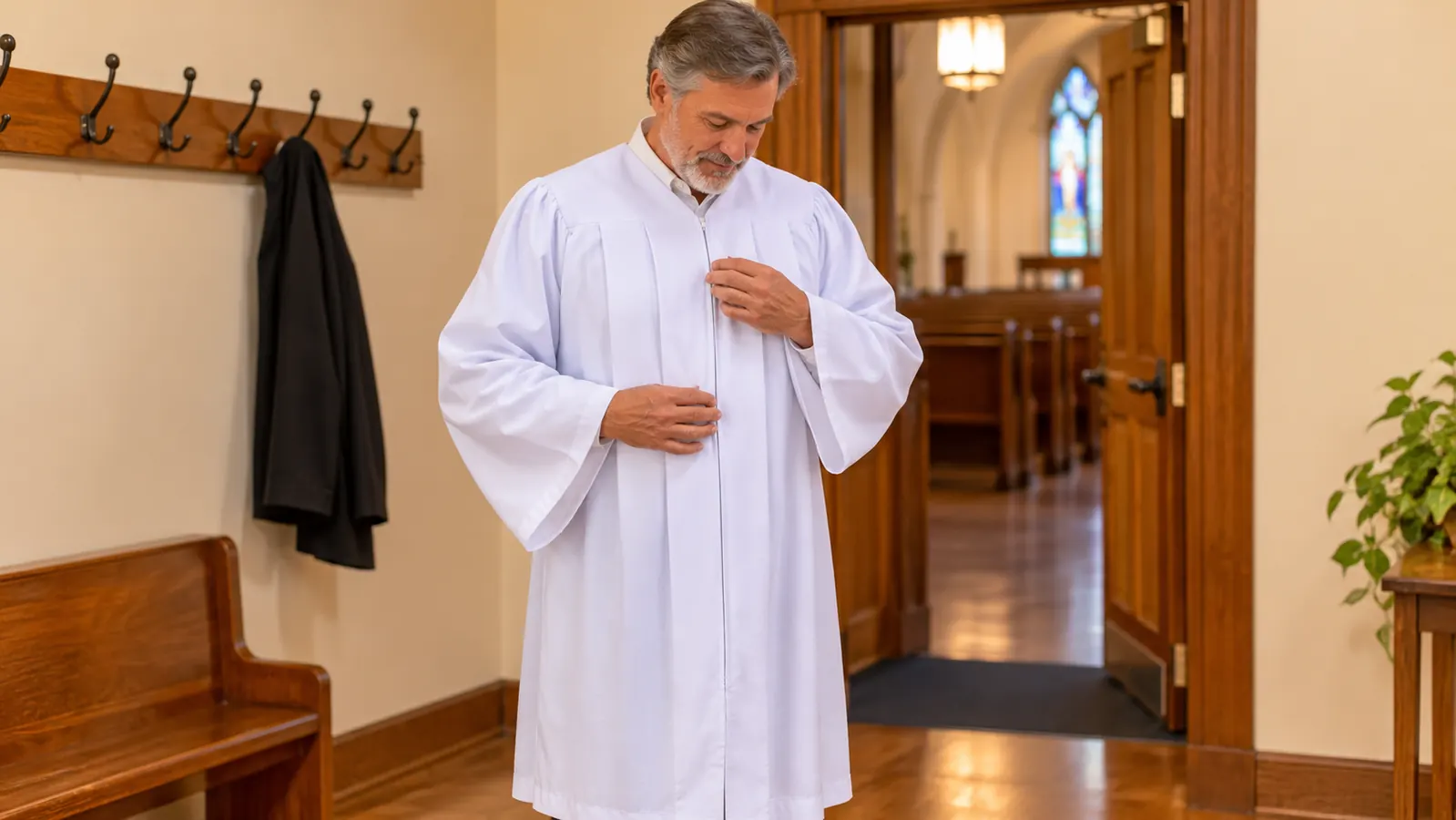
If your church is working with a tight budget and a volunteer choir that runs from a soprano in her forties to a tenor who has been singing since the Reagan administration, the GradPlaza choir robe is the kind of piece that makes the whole job easier. It is a polyester ceremonial gown, lightweight by the listing's own description, machine washable, loose fitting, calf length, with a V-neck. None of that sounds exciting. All of it matters when you are the one carrying the laundry basket up the fellowship hall stairs in July.
One robe, washed and worn, before your committee spends a dime
The GradPlaza robe is machine washable polyester, cut loose at calf length. Order a single one in your most average size and let it survive a real Sunday first.
Amazon Check Today's Price on Amazon →Five Steps That Keep a Robe Committee Out of Trouble
Step 1: Measure Everybody, Then Size Up
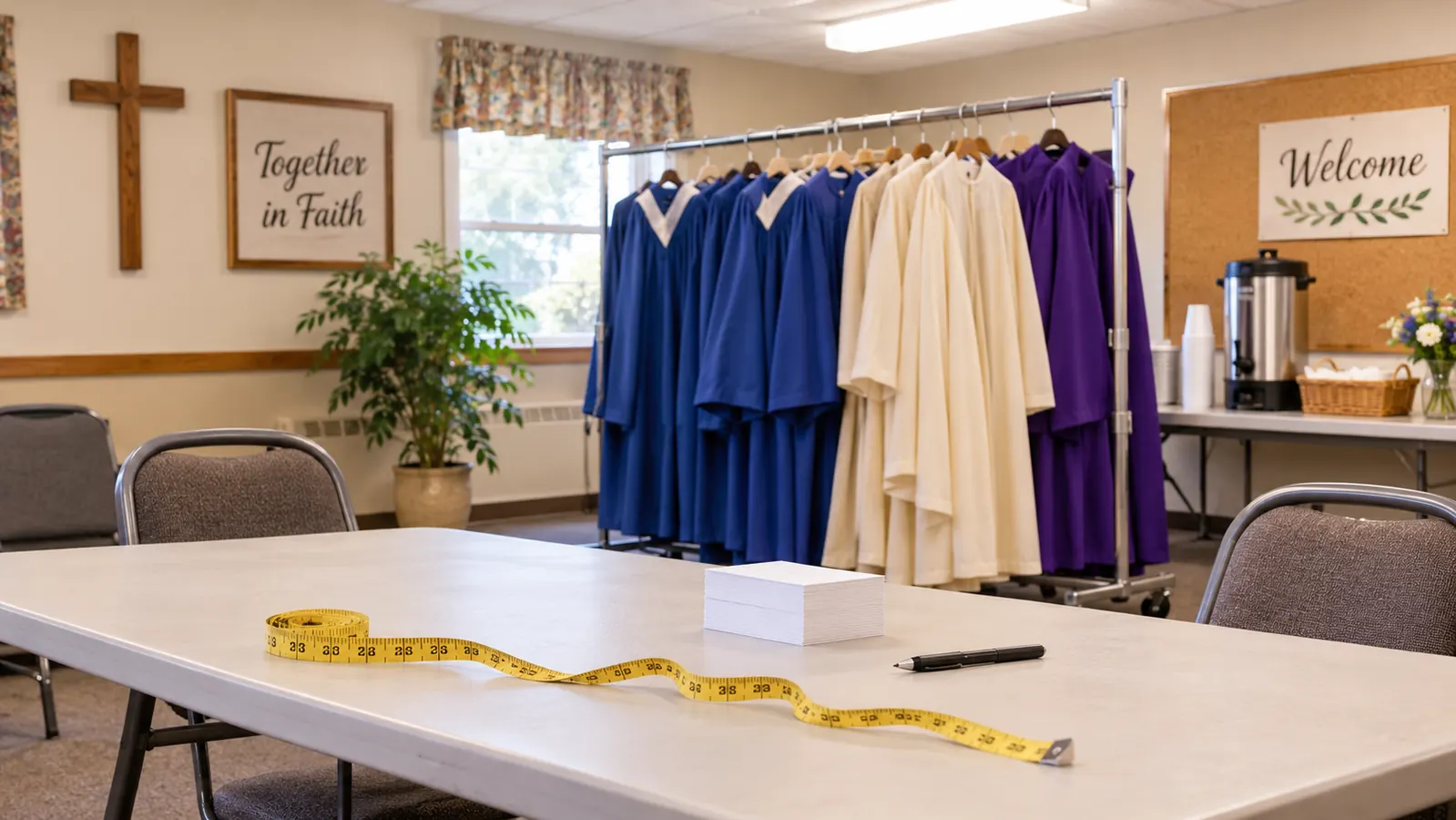
Do this in the fellowship hall after a Wednesday rehearsal, not over text messages. Two people measure, one holding the tape and one writing, because a singer measuring herself in a bathroom mirror will guess and round down. You want four numbers: chest, waist, hip, and shoulder to the point where you want the hem to land. Add the shoes she will actually wear on Sunday, since a two inch heel changes everything about a hem.
Then write it down. We keep an index card for every singer in the closet: name, height, the four measurements, the size we ordered, and the date. When somebody new joins in October, we do not start over from nothing. When somebody loses twenty pounds or gains it back, we update the card. This sounds like paperwork for the sake of paperwork. It has saved us from reordering the wrong size four separate times.
One Wednesday last September we measured nineteen singers in about forty minutes, two at a time at the folding table, and the whole effort cost us a pack of index cards and a fresh pen. The singer who insisted she was a medium turned out to be a large by the tape, and she was gracious about it once she saw the number written down in front of her. Numbers end arguments that opinions start. If a singer cannot come on a Wednesday, measure her on a Sunday after the benediction, before she takes off her shoes and heads for the parking lot. The measurement takes ninety seconds. A robe ordered wrong takes six weeks and a phone call to fix.
One thing the listing says plainly, and our singers confirmed it: this robe runs slightly small. If a singer lands between two sizes, order the larger one. A loose fit is forgiving and it layers over a blouse or a dress shirt without pulling across the shoulders. A tight robe looks tight from the back of the sanctuary, and nobody wants to sit down in one.
Step 2: Settle the Fabric and the Finish Before You Fall for a Photo
Almost every robe you see photographed online looks lovely, because the photograph was lit for the robe. Your sanctuary is not that photograph. Our loft sits under four warm fixtures and a ceiling that holds heat, and by the second service in August the whole choir knows which garments breathe and which ones do not. Lightweight polyester is what works for us. Read the care instructions before you buy anything, and if the listing does not say machine wash, assume hand wash and plan accordingly.
Finish matters more than most committees expect. A shiny weave throws the light back at the congregation and shows every crease from the folding table where the robes sat all week. A flat matte finish absorbs the light instead, so the choir reads as one group rather than thirty separate reflections. Stand in the sanctuary with a sample and hold it under the lights before you commit. If the fabric sparkles in your hand, it will sparkle more from the third row.
The first sample our committee ever ordered came from another supplier entirely, and it looked wonderful sitting in the box on my dining table. Under our loft lights it turned into a mirror. I brought it home and washed it once on gentle, and it came out with creases set into the shoulders like it had been folded in a drawer since spring. That was the year we started asking two questions before anything else: what is the garment made of, and what does the label say about washing it. A fabric that tolerates a machine wins. Anything that wants a dry cleaner will live in a bag in my hallway until Easter.
The GradPlaza robe is polyester and machine washable, which is the combination I care about most, because a volunteer choir will spill coffee on a Wednesday and need that robe back on a Saturday. A light fabric also hangs dry in a few hours on a hanger in the closet instead of sitting damp in a laundry bag until Thursday. That is not a small thing in Florida.
Step 3: Get the Length Right for Your Risers
Calf length is a good default for a volunteer choir, and it is what this robe is cut to. It clears the riser step, it does not pool on the floor when a singer sits between services, and it leaves room for a shoe without showing a sock. Measure on the riser, not on flat ground, and measure from the shoulder rather than the waist, because shoulders are where a robe actually hangs.
Here is the mistake I made in year two. I measured everybody flat on the fellowship hall floor, ordered to those numbers, and then watched the hems ride up what looked like six inches the moment the choir climbed onto the risers. A riser is a step, and standing on a step changes where the shoulder sits relative to the hem. Now we measure with the singer standing on the bottom riser in the shoes she will wear that Sunday, and I hold the tape at the shoulder myself. It costs an extra minute per person. It saved us from a second order that year, and a second order was not in the budget.
We keep a hem kit in the closet: thread, a packet of iron on hem tape, small scissors, and a pin cushion. One of our altos sews beautifully and does not mind staying twenty minutes after rehearsal, and that arrangement has done more for how our choir looks than any single purchase we have made. Twenty minutes of hemming beats a return shipping label and six weeks of waiting.
If your choir is mixed height, resist the urge to buy one length and hope. Order to your tallest singer's measurement and hem the rest down. You can always take fabric off. You cannot put it back.
Step 4: Buy One and Put It Through a Real Sunday
Before the committee spends the year's music budget, buy a single robe in the size your most average singer wears. Wash it the way the care label says. Hang it. Then hand it to the tallest person in the choir and the shortest person in the choir on consecutive Sundays and ask them to report back. Can they lift their arms to turn a page? Does the V-neck sit right over a blouse collar? Does the robe stay where it should when they sit down between the anthem and the sermon?
We did this with the GradPlaza robe before we ordered twenty eight of them. The report came back with two notes. First, it needed to be ordered a size up for two of our singers, which matched the fit note on the listing. Second, it survived a full Sunday including a covered dish lunch, which is a better durability test than anything I could design on purpose. Two washes later it still hung straight and the hem had not moved.
A test robe also gives you something to hold up in front of the congregation when you explain why the committee is asking for money. People give more readily to a thing they can see and touch than to a line item in a budget sheet.
We have never once regretted ordering the larger size. We have regretted the smaller one every single Christmas.
Step 5: Build a Closet That Survives Five Seasons
Label the inside of the collar with a fabric marker and the size, not the singer's name. Singers move, graduate, take a job in another state, and the robe stays behind. A size label means the next person can wear it without convening a committee. Keep a clipboard on the closet door with a sign out column, and ask people to write the date. It is unglamorous and it ends the Friday night phone calls.
We number them now, inside the collar, right below the size. Robe fourteen, size large. When a singer signs one out, the number goes on the clipboard beside her name and the date. The first Christmas we did this, a robe went missing after the late service and turned up on the second Sunday in January in the back seat of a car. Without a number it would have stayed a rumor and a general sense that something was gone. With a number, three people knew exactly which robe was missing and one phone call found it before the following Wednesday.
Hang robes on sturdy hangers with a little room between them, out of direct sun, and keep a couple of sachets in the closet so the smell of a warm fellowship hall does not settle into the fabric. Ours live behind a curtain, which is the cheapest fix we ever made. Store two spare robes in the two most common sizes, because someone will always join in November.
And put a small line in next year's budget for replacement, even if it is modest. A robe closet that never gets a line item is a robe closet that gets replaced in a panic. Ours has run on that principle for years, and the choir still looks like the choir.
What Else Helps
A few small things make the whole system work. Keep a cloth tape measure in the closet and not in somebody's sewing room, because that tape measure is the most borrowed object in the building. Write the size chart on the inside of the closet door so a new singer can find her own size without tracking down a committee member. Ask the choir to return robes the same Sunday they wear them, and say so in the bulletin once a month, because volunteers are not forgetful on purpose.
For the Christmas and Easter services, when the loft is full and the lights are up, a flat finish reads better in the photographs the congregation will keep, and it reads better from the back row too. If your church is looking at new robes this year, order the sample first, wash it, hem it, and let the choir wear it before the committee signs anything. The robe should serve the singing, not the other way around.
Start with one robe and one Sunday
Machine washable polyester, loose fit, calf length, V-neck. Order one in your most common size, put it through a rehearsal and a service, and let the closet make the decision for you.
Amazon See the GradPlaza Robe on Amazon →