
The robe closet in our fellowship hall sits against an outside wall, and for years I could not figure out why the robes on that side smelled like a wet basement by late August. We washed them. We pressed them. We hung them back in the same spot, and by the next Sunday the shoulders had that folded crease again. It took me three seasons to understand that the washing was never the problem. The storage was.
I am Gloria Pettaway. I sing alto in the Sanctuary Choir at Greater Mount Zion here in West Palm Beach, and for a long stretch of those thirty-some years I have also been the one who keeps the robe closet. About thirty voices, two big services at Christmas and Easter, one spring concert, and a sanctuary that turns into a steam room under the lights in July. What finally changed things was not a new detergent. We moved the choir into SAY HO UM garment bags, the sixty inch full length kind with a five inch gusset, one robe in each. The creases stopped coming back and the closet stopped smelling like a car left shut in the sun.
Thirty robes, thirty bags, and a closet that finally smells like a closet
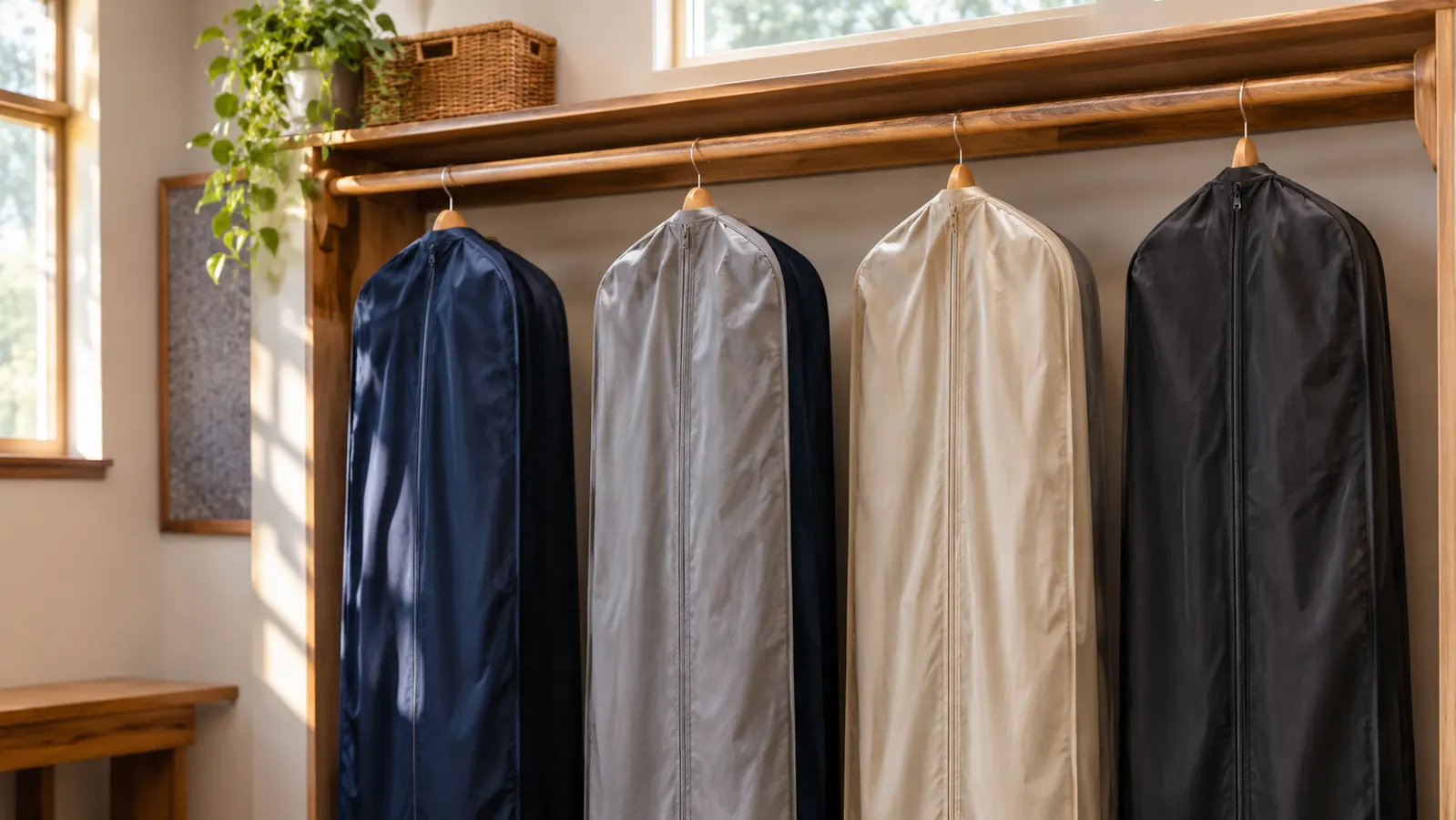
This is the bag our choir has used for three seasons running: sixty inches long, five inches of gusset so the hem hangs free, breathable 600D polyester, and a full zipper closure.
Amazon Check Today's Price on Amazon →Why Robes Wrinkle and Why They Smell
Two things ruin a stored robe, and neither of them is time. The first is moisture. A choir robe is usually a polyester and wool blend with a lined front and a doubled hem, and that doubled hem holds water long after the outside of the fabric feels dry to the touch. Trap that moisture in a closed space and you do not get a stain. You get a smell that comes back every time the robe warms up.
The second is weight. All of a robe hangs from two points at the shoulders. If the robe is crammed against six others on a tight rod, the fabric has nowhere to fall, so it folds where it is touching and stays folded. That is the crease you see across the chest on Sunday morning, and it was set on a Tuesday in July.
So the fix is not one product. It is a routine with five parts, and every part matters. Skip the drying step and the best bag in the world will just hold the smell in a little more efficiently. Skip the closet step and the bag is fighting a losing battle against a sweating wall.
Step 1: Make Sure the Robe Is Dry All the Way Through
A robe can feel bone dry on the outside and still be wet at the collar band and the hem facing, and those are the two places mildew starts. Before anything goes back in the closet, hold the collar in both hands and press your thumbs into the seam. If it feels cool against your skin, it is still damp. Do the same at the hem, where the fabric is doubled and holds water like a sponge.
Our robes take about four hours on a rack in the fellowship hall with the ceiling fan running, or overnight if the air conditioning is off for the week. Two rules came out of the third ruined summer. Nothing goes into a bag the same day it comes out of the wash, no matter how late it is. And nothing hangs with the sleeves pressed flat against the body while it dries, because that is how you bake a crease into the shoulder that no iron will take out.
If you are washing more than one robe, give them separate rods or leave six inches between them. Fabric that touches while it dries dries more slowly at the touch points, and those are the spots that come back smelling like a towel left in a gym bag.
Step 2: Hang It So the Weight Sits on the Shoulders
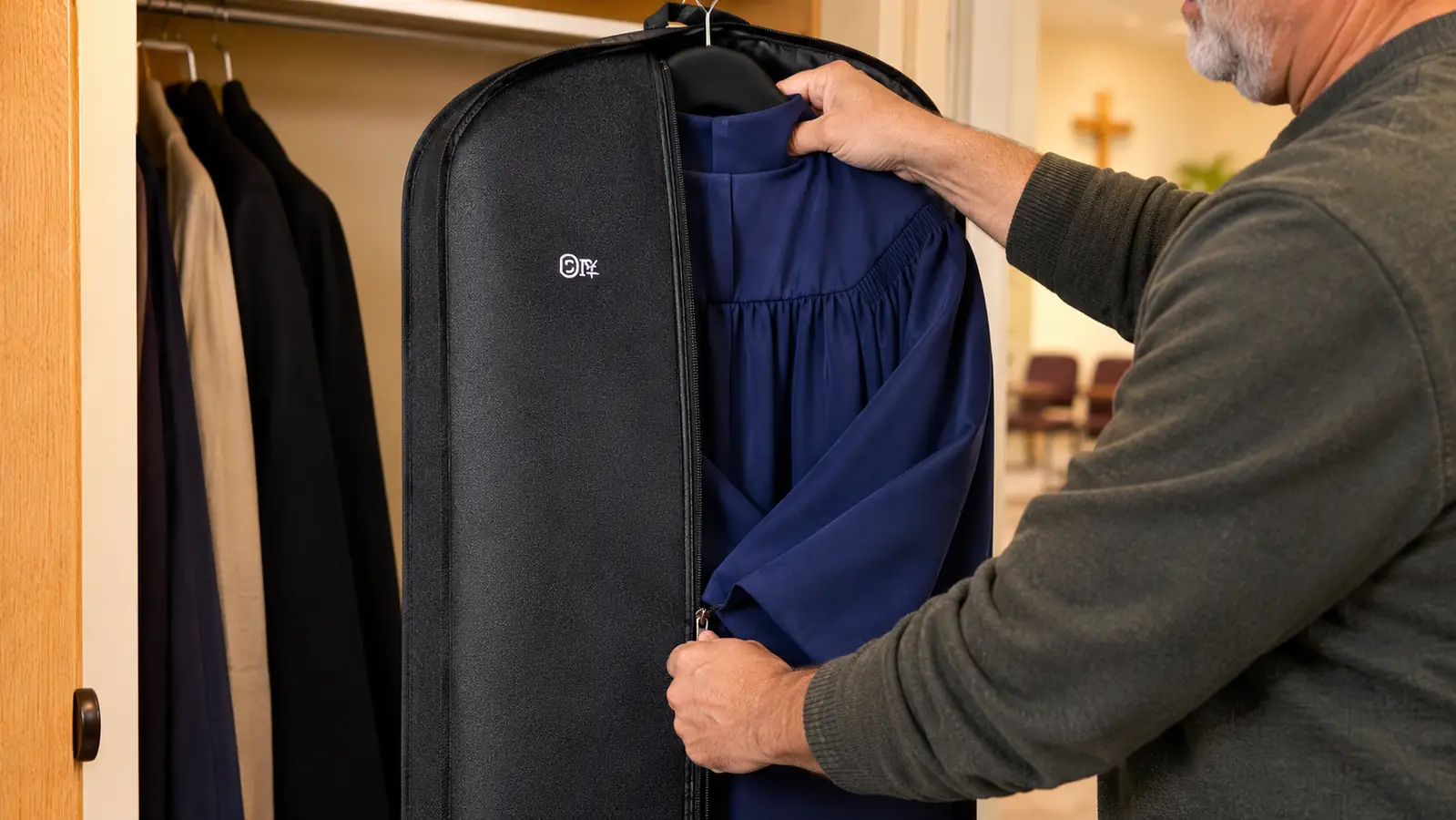
A choir robe is heavier than it looks, especially the lined ones, and every ounce of that hangs from two small points at the shoulder. Use a hanger wide enough to reach the shoulder seams and shaped enough that it does not dig a ridge into the fabric. The thin wire hangers from the dry cleaner will leave two sharp peaks by morning. I have thrown away more of those than I can count.
Lay the robe on the hanger with the back seam centered and the shoulder seams sitting on the shoulder of the hanger, not sliding toward the neck. Bring the sleeves forward and cross them gently at the waist. Do not fold a sleeve at a sharp angle and do not tuck one under the other. Gentle crossing, then leave it alone.
The other thing that hangs wrong is the hem. If the bag is shorter than the robe, the hem sits folded over at the bottom of the bag and that fold becomes a permanent line. Our robes run 54 to 59 inches from shoulder to hem, which is why we settled on the SAY HO UM 60 inch bag with the five inch gusset. The extra length means the hem drops all the way down and hangs free instead of curling up in the bottom like a sleeping cat.
Step 3: One Robe Per Bag, and Let the Gusset Do Its Job
The temptation, when you have thirty robes and a closet the size of a pantry, is to put two robes in one bag and call it even. I did that for two years. What happens is that the two robes press against each other all summer, and the folds set exactly where the fabric was touching. The bags survive fine. The robes do not.
One robe per SAY HO UM bag. The five inch gusset gives the robe room to sit without being crushed, and the material is 600D polyester, which is water resistant on the outside and breathable enough that the air inside is never fully sealed off. That second part matters more than most people realize. A bag that traps air turns a slightly damp robe into a mildew experiment. A bag that breathes gives the fabric one more chance to finish drying.
Zip it closed all the way, every time. The closure on this bag is a zipper, and a zipper left half open is an invitation for dust and for the robe to slide off the rod on a Sunday morning when you are already late. Then hang it so the bag is not pinned against the wall or the next bag. If you can fit a hand between two bags, they have enough room.
The crease is not set on Sunday morning. It gets set on Sunday afternoon, the moment a warm robe goes into a closed bag and stays there.

Step 4: Fix the Closet, Not Just the Robes
You can do everything right with the robe and still lose it to the room. Our closet was against an outside wall, and in a West Palm Beach summer that wall sweats. Moving the rod to an interior wall did more for the smell than anything we bought, and it cost us one Saturday morning and a borrowed drill.
A few cheap fixes. Keep the robes at least a foot off the floor, because the floor is where the cool damp air sits. Leave a gap between the bags and the wall so air can move behind them. Do not stack boxes of old hymnals and Christmas pageant costumes against the back of the closet, because paper holds moisture and blocks the circulation. And if your fellowship hall has ceiling tiles, look up. We had a brown tile stain above the robe rod for a year before anyone connected it to the smell.
Humidity is the number worth watching. A small gauge from the hardware store costs very little and tells you more than your nose will. I check ours on the first Sunday of the month and write the number on the clipboard. When it climbs, I run a box fan in the closet for an afternoon with the door open. In the rainy season I keep a moisture absorber on the shelf, not against the fabric, and swap it out when it is spent.
Step 5: Label It, Log It, and Check It Every Quarter
When a robe goes missing in a volunteer choir, it is almost never stolen. It is misfiled, or it is in a bag with no name on it, or it went home with somebody after the Easter service and came back in September. Every bag gets a card: name, size, and the month it was last checked. That card has ended more arguments than any committee meeting I have sat through.
We keep a clipboard in the closet with one line per robe. It sounds fussy for a church, but it takes ten minutes in January and saves an hour in April. Sizes change. People lose and gain weight, teenagers grow four inches in a year, and the robe that fit a soprano two seasons ago is now living on the alto rack.
Twice a year, before Christmas and before Easter, take every robe out, unzip every bag, and put your face in it. If it smells like a closet, it goes to the wash. If the hem is dragging on the risers, it gets re-hemmed before it goes back. Then hang everything up, check the gauge, and shut the door. That is the whole routine, and it takes one afternoon for thirty robes.
What Else Helps
Do not put mothballs anywhere near a robe you intend to wear in public. The smell soaks into the fabric and comes back every time the robe warms up under the sanctuary lights, which means the person behind you in the processional gets the full benefit. Cedar blocks or a lavender sachet in a cloth bag on the shelf are gentler, and they do not follow you down the aisle.
Let robes air out before they go back in the bag. After a service, hang them on a rack in the fellowship hall for half an hour while the choir drinks coffee and argues about the tempo on the last hymn. Body heat and a little perspiration are what start the smell in the first place, and thirty minutes of moving air does more than an hour in a dryer.
For wrinkles, steam beats an iron every time. A hot iron on a polyester blend will leave a shine at the seam that never comes out. Hang the robe in a steamy bathroom after somebody has taken a shower, or run a handheld steamer a few inches from the fabric and let the weight of the robe pull the crease down. If you must press, put a cloth between the iron and the robe and keep the iron moving. Never let it sit.
And carry robes in the bag, not over an arm. The walk from the parking lot to the choir room in a Florida afternoon downpour is where most of our stains came from. The SAY HO UM bags have held up through three seasons of that, and the water resistant outside means a dash across a wet parking lot is not the disaster it used to be. Wash them down with a damp cloth at the end of the season and let them dry open before the robes go back in.
Give every robe in your closet its own sixty inches of breathing room
Sixty inch length, five inch gusset, breathable 600D polyester, full zipper closure. One robe per bag is the whole method, and this is the bag that made it work for our choir.
Amazon Check Today's Price on Amazon →