
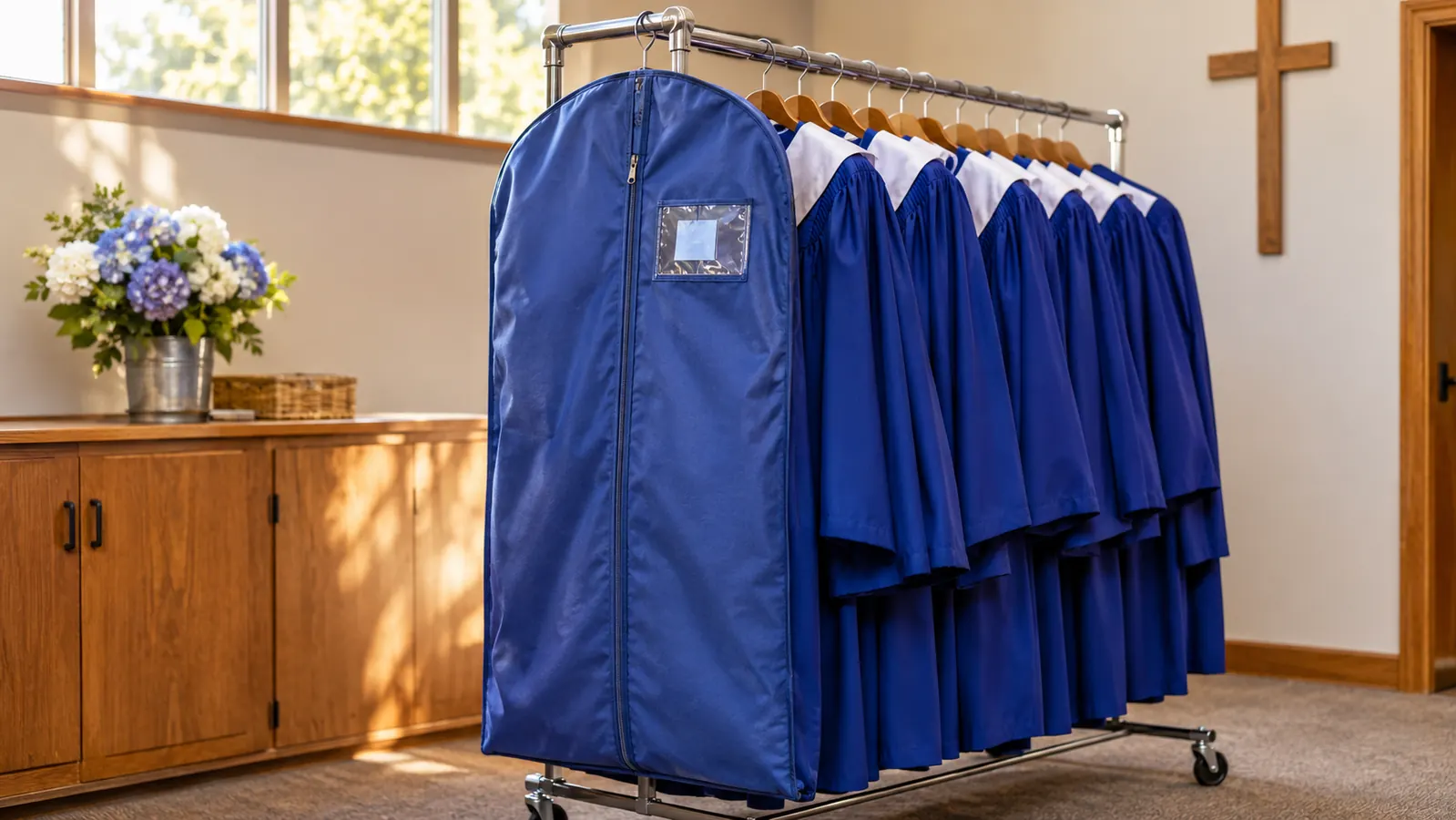
Nobody tells you that a choir robe closet has its own small weather system. Our fellowship hall in West Palm Beach runs warm and damp from June through October, the rolling rack sits directly under a ceiling vent, and thirty robes hang close enough together that the shoulder of one presses into the sleeve of the next. For years we kept them in the thin plastic bags that come home from the dry cleaner. Every September I would pull one down and find the same two things: a crease across the shoulders that would not hang out, and a smell like a closed suitcase. I am Gloria Pettaway, alto, and I have been the volunteer wardrobe coordinator for the adult Sanctuary Choir at Greater Mount Zion for a good many years now. When the robe committee finally freed up a little money, I went looking for a real storage bag, and the SAY HO UM 60 inch robe garment bag is what I bought.
This is the honest version of what I learned, including the parts I would have wanted someone to tell me before I ordered. Plenty of reviews will tell you a garment bag is a good idea. It is. But a robe bag is not a magic sleeve. It is a piece of fabric with a zipper on it, and whether it helps you comes down to three measurements: how long it is, how deep it is, and whether air can move through it. Get those right and your robes will look in May the way they looked in October when you put them away. Get them wrong and you have spent money to store a problem. So here is what the SAY HO UM bag actually did in our closet, and the two places it made my life harder.
The Quick Verdict
Long enough for our tallest singer's robe and breathable enough that the September smell is gone. Solidly built. The five inch gusset is the reason to buy it and also the reason it eats your shelf space.
Amazon Check Today's Price →The bag that ended our September crease problem
Sixty inches long, five inches deep, breathable polyester with a full length zipper. Check today's price and availability on Amazon.
Amazon Check Today's Price on Amazon →What Nobody Tells You Before You Buy a Robe Bag
The first thing nobody tells you is that a robe bag is a storage tool, not a carrying case. I say that plainly because I watched a well meaning committee member order something similar for our spring concert travel, then discover that a sixty inch bag with a five inch gusset is a great deal of bag to hand a singer climbing onto a church bus. This bag is built to hang in a closet and stay there. If your actual need is moving robes from the fellowship hall to the sanctuary and back every week, that is a different product and I would not spend the money on this one.
The second thing is that breathability matters more than thickness. You would think the heaviest bag is the safest, and in a Florida fellowship hall it is the opposite. A robe sealed inside something airtight holds whatever moisture was in the fabric when you zipped it, and by September that moisture has become a smell you cannot wash out easily. The SAY HO UM bag is 600D polyester and it is breathable, made so air circulates around the robe instead of sitting on it. That single quality is why our closet smells better than it did three years ago. Not because the bag is fancy. Because it lets the robe finish drying.
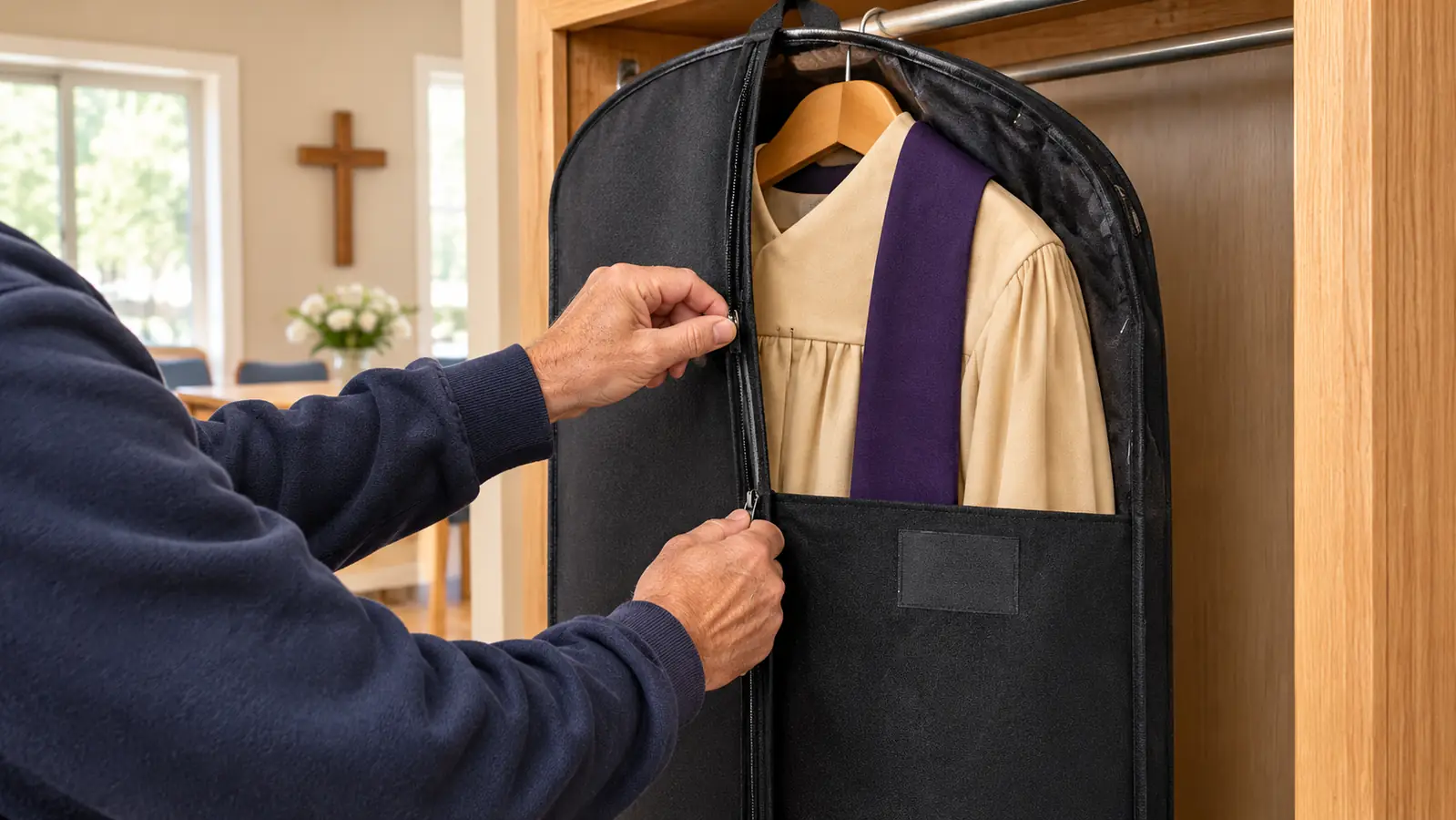
The third thing, and the one I most wish someone had said out loud, is that no bag fixes a robe you stored badly. If you wad a robe onto a wire hanger and zip it into anything, you will get a crease and the bag will hold it there for you. The bag protects what you do before you zip. Hang the robe on a hanger with shoulders that are actually shaped, close the buttons or the front zipper so the front lies flat, smooth the sleeves down with your hand, and then put the bag over it. Do that and the bag earns its keep. Skip it and you have paid for a sleeve that keeps a bad job in place for eleven months.
How I've Used It in the Robe Closet
We started with six bags, not thirty. That was deliberate. I wanted to see a full Florida summer before I asked the committee for more money. Those first six went to the robes in the worst shape, the heaviest fabric and the widest shoulders, because heavy fabric is where creases set hardest and where thin plastic does the least good. I labelled every one with a strip of masking tape across the front, because there is nothing on the outside of a garment bag that tells you what is inside it, and a closet full of identical bags is a guessing game at 7:40 on a Sunday morning when the processional is at 8:15.
That first six went in on the last Saturday in August, which in our hall is the worst week of the year to hang anything. The vent had been dripping condensation all month and the room smelled like a wet towel. I hung two robes that were still faintly damp from the wash, deliberately, because I wanted to know the worst case rather than the best. When I opened those two bags on the second Sunday of October, the fabric was dry and the smell was gone. I cannot prove the bag did that and not the eleven weeks of ordinary air, but I know what the same test did in a plastic bag the year before, and it was not that.
By the following September the difference was real but not dramatic, and I want to be straight about that. The robes were not transformed. They were simply not worse. Same shoulders, no new crease, no smell, no dust film on the fabric that I used to wipe off with a damp cloth before service. Six bags did not change our closet. What they changed was my confidence that a robe could sit in that room for eleven months and still be usable on the other side.
The next spring we bought more and phased out the plastic entirely. Two years in, I have had one zipper give me trouble, on a bag where a singer had jammed in a robe plus a spare stole. I worked the slider back down, cleared the fabric, and it has been fine since. That is one stubborn zipper across a couple of dozen bags and two years of Sundays, which I consider a fair record.
What the Fabric and the Zipper Are Actually Like
The fabric is a heavy woven polyester, and it feels like something a duffel bag would be made of rather than something a dry cleaner would hand you. It is water resistant, which means a splash or a damp hand wipes off and does not soak through. It does not mean waterproof, and I would not hang these under a vent that drips or against a wall that sweats. I learned that the hard way with a different product in a different closet. Between seasons I wipe each bag down with a damp cloth and let it air before I put anything back inside it, and after two years none of them have gone stiff or cracked at the folds.
The closure is a zipper that runs the full length of the bag, which is the right choice for something sixty inches tall. A shorter zipper would mean folding the robe to get it in, and folding is exactly how creases begin. The trade is that a full length zipper is a long piece of hardware, and near the top corner, where the bag narrows around the hanger, you have to slow down and hold the fabric clear with your other hand. Zip it fast and you will catch a bit of polyester in the teeth. The listing quotes a 4.6 average across more than 1,900 reviews, and honestly that matches my experience: good, not flawless, and the flaws are the kind you learn to work around in a week.
Sixty inches long and five inches deep. That is what lets a fifty-eight inch robe hang with the shoulders still shaped, and that is the number our closet actually needed.
The 60 Inch Number, and the Five Inches That Surprised Me
Our robes run from fifty-two inches on our shortest soprano to fifty-eight on a gentleman in the tenor section who stands six foot two. The SAY HO UM bag is sixty inches long, and the listing puts it at garments in the fifty-four to fifty-nine inch range, which is exactly what I found in practice. The fifty-eight inch robe goes in with room below the hem so it hangs free instead of curling under. That sounds like a small thing until you have spent a Saturday morning steaming hems that curled in storage because they had nowhere to go.
The five inch gusset is the part I did not expect to care about. A flat bag holds a robe the way a book holds a pressed flower. Five inches of depth gives the robe somewhere to sit besides flat against itself, so the shoulders keep their shape and the sleeves do not press into the body of the garment. In a closet where the alternative is thirty robes flattened into a stack, that is worth a great deal. It is also, being honest, why these take up more of my rack than the old plastic did. The bag measures twenty four inches wide, five inches deep and sixty inches tall, and thirty of them is a serious footprint.
Here is the arithmetic I wish I had done first. Our old rack held thirty two plastic bags in four feet of width. The same four feet holds twenty four of these, which is why the first thirty bags went up in two waves instead of one and why Walter spent a Saturday in March moving the rack six inches closer to the door. If you are hanging fewer than a dozen, none of this matters. At thirty, it decides your layout.
What I Liked
- Sixty inches long, so our tallest singer's fifty-eight inch robe hangs without the hem curling
- Five inch gusset keeps the shoulders shaped instead of pressing the robe flat against itself
- Breathable 600D polyester, which ended the closed suitcase smell in our closet
- Water resistant surface wipes clean with a damp cloth between seasons
- Full length zipper means the robe goes in unfolded, which is where creases start
- Rated 4.6 across more than 1,900 reviews, close to what I experienced over two years
Where It Falls Short
- Five inches of depth takes real space. Measure your rack before you order thirty
- It is a storage bag, not a travel bag. I would not send one on a church bus
- Water resistant is not waterproof. Do not hang these where a vent drips
- Nothing on the outside tells you which robe is inside. Label them yourself
- The full length zipper takes two hands near the top corner or it will catch fabric

The Parts I Don't Love
The space is the honest trade. If your rack is wedged into a closet the width of a doorway, five inch bags will hold fewer robes per foot than flat plastic did, and you will notice it the first week. I had to move a shelf to make room and I am still not entirely over it. The second complaint is smaller but real: that long zipper near the top corner. You cannot rush it. I have caught fabric there twice, both times on a Sunday, both times with somebody waiting.
The first of those two was the Sunday after Easter, which is the worst possible Sunday to be slowed down, because eleven robes come back from the seasonal service at once and every one of them needs hanging. I was working fast and caught the hem of a sleeve in the teeth about three inches below the corner. It took me a minute with a flashlight and a great deal of patience to walk it back out without tearing anything. Nothing was damaged. But I have zipped these bags more slowly ever since, and I now tell every volunteer the same thing: hold the fabric clear, then pull.
And I will say the thing no product listing will say, because it is a limit rather than a flaw. A bag does not clean a robe. It does not press one. It does not replace the annual wash, the hem check, or the Saturday I spend with a needle and thread and the radio on. What it does is protect work you already did. I still wash every robe once a year. I still check every hem before Easter. The bags simply mean that the robe I washed in August is still worth wearing in May.
Who This Is For
This is for the person responsible for somebody else's robes, who has a closet, a rack or a spare room to hang them in. Choir wardrobe volunteers, church sextons, the one alto who ends up with the vestments in her guest room because the fellowship hall flooded in June. It suits heavy fabric: wool blends, brocade, anything with trim that crushes or a lined shoulder that shows every fold. It suits a climate like ours, where the enemy is damp rather than dust. If you are hanging a small set of light cotton robes in a cool, dry closet, it is more bag than you need, though it will not hurt anything except your shelf space.
Who Should Skip It
Skip it if you need to move robes rather than store them. Skip it if your closet is twenty two inches deep and already full, because the gusset will not squeeze and you will be cross about it. Skip it if the garment in question is a lightweight cotton you wash after every single wearing, since a bag adds little to something that never sits long enough to crease. And skip it if you are hoping a bag will rescue a robe that already has a hard set crease across the shoulders. Steam it, hang it, then bag it. The order matters more than the product.
If I Were Starting the Robe Closet Over
I would buy fewer bags than I thought I needed, and I would buy them for the heavy robes first. I would label each one on the outside with the size rather than a name, because singers come and go and sizes stay put. I would measure the rack before ordering anything at all and leave a few inches of air between bags so the breathable fabric has somewhere to breathe into. I would write the wash date on the tape in marker, because in a room with no windows, memory is not a plan. And I would buy one bag first and live with it through a summer before spending the choir's money on thirty.
One more thing I would do, and it costs nothing. I would take the measurement of the longest robe in the closet and write it on the inside of the closet door in marker, so the next volunteer does not have to guess. Ours reads fifty eight inches, and it has saved three separate arguments in the robe committee about whether a shorter bag would do. It would not. Knowing that before you shop is worth more than any review, including this one.
None of that is on the product page. It is just what thirty years of Sunday mornings teaches you. The bag itself is a good one. It is long enough, deep enough and breathable enough for what our closet asks of it, and after two years I would buy it again. I would simply measure first, and I would start with six.
Long enough for the tallest robe in the loft
Sixty inches long, five inch gusset, breathable 600D polyester and a full length zipper. More than 1,900 reviews at a 4.6 average. Check today's price on Amazon before your next robe Sunday.
Amazon Check Today's Price on Amazon →